
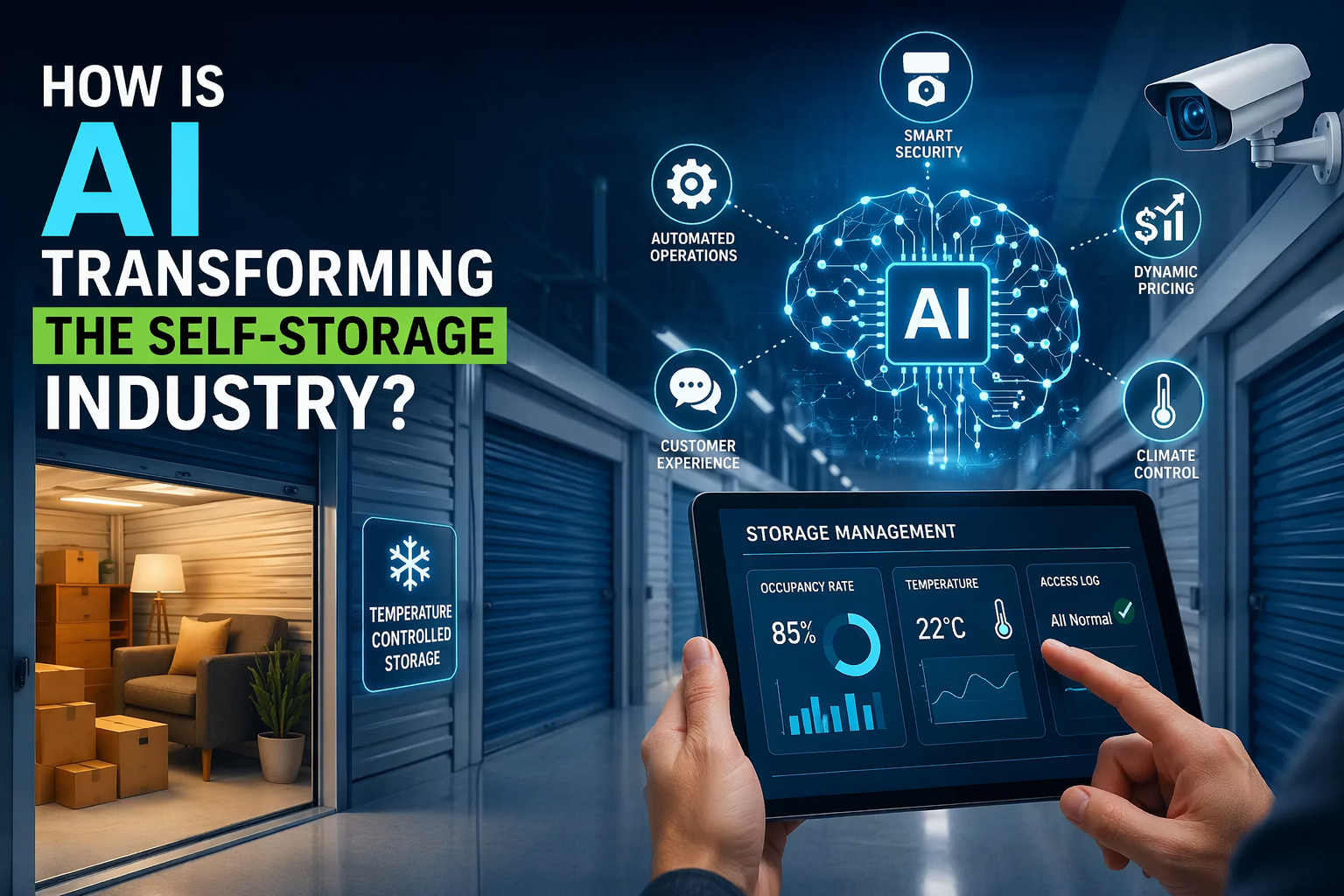
The self-storage landscape shifted dramatically in the past several years. Gone are the days when any aspect of a business’s operational process relied on paper contracts, manual gates and customer service located at an office.
Artificial Intelligence (AI) lies at the heart of this transition. Storage companies are leveraging AI to drive operations, security, efficiency, and enhance a seamless customer experience. With growing consumer expectations, organisations that are implementing smart tools for their customers are getting ahead.
Customers today prefer instant access, even to the point of booking online, secured ID verification and flexible pricing. The long wait for office hours and tedious paperwork has put them past this stage.
A lot of these pain points are resolved by AI as it allows you to automate tasks and even forecast customer needs beforehand. AI provides a powerful ally for your storage business, from security cameras that seem to know when something is suspicious to chatbots that answer questions without missing a beat. Such as temperature controlled storage and also temperature controlled storage units, there is additionally a rising demand for numerous expert options.
Customers who store electronics, documents, antiques, furniture and other sensitive goods expect the proper environment. Today, operators can monitor conditions remotely in real time using AI at a fraction of the cost. This means enhanced customer service, as well as operational efficiency for companies.
Understanding the Rise of AI in Self-Storage
There are two primary challenges in the self-storage industry: escalating operating costs and ever-rising customer expectations, which explains the steady uptake of AI across the sector. Many old management systems need additional staff time and can tend to be slow. Whether it is booking confirmations, payment reminders, tenant communication, or even occupancy reporting, any mundane work can be automated through AI. It helps teams devote themselves to service and growth rather than administrative work.
Digital convenience has become essential. Consumers have begun looking for storage over the internet, price-shopping across different facilities, and expecting to move in immediately. Through AI, websites find out how visitors behave, and you can direct website visitors to the correct sizing of your gadget without difficulty, as well as an accurate leasing plan or features package. Think of it like your own super-advanced, all-sleepless sales-guy.
AI is also being utilised by storage operators to gain insights from business data. This way, instead of assuming the upcoming demand, they are able to compute and analyse trends along with historical occupancy data and seasonal patterns so that better decisions are made. This means a more intelligent business model with fewer vacant locations and more robust profits.
AI-Powered Security in Modern Facilities
One thing that has always been a top priority in self-storage is security. And now, AI is making it more potent than before. Now, smart surveillance cameras can detect any abnormal movements, loitering and illegal entry or activity after hours. AI systems flag suspicious events right away so that staff can respond much more quickly rather than just relying on human monitoring.
Access control has also improved. Nowadays, mobile applications, license plate recognition, digital keypads, and identity verification systems are used in many facilities. AI can link these tools together to build more intelligent entry points. This is crucial for surveillance as the system can notify management in case of abnormal access patterns.
For customers, this builds confidence. Storage of valuables makes people feel like their stuff is protected. AI brings an additional level of trust to the table with speed, accuracy and never tiring.
Better Customer Service Through Automation
Artificial intelligence tends to offer the most significant change when it comes to 24/7 customer support. Chatbots can respond to standard questions relating to unit sizes, pricing, dates payments are due, when the location is accessible and the availability itself. Customer service is available at midnight as readily as it is during the day.
Move-ins are also becoming easier. But for that, AI booking systems can direct users in under a minute to pick a unit, sign documents, pay for it, and obtain the instructions to access their choice. And that friction point is reduced, conversions increased.
How do you perceive AI as a digital front-end at the desk that never shuts? Get it to do the routine stuff very rapidly, and human beings staff your operation to deal with all of the more complicated supply and customer needs. That balance raises satisfaction and reduces pressure on staffing.
Smarter Pricing and Revenue Management
Traditionally, pricing was based on some crystal ball or an annual job review. Dynamic pricing models that are made possible by AI change that. It does this by looking at local demand, occupancy rates, competitor pricing and seasonal trends to suggest the optimal rental price.
What you have is a pricing mechanism based on demand, so if, for example, the demand rises during the summer moving season, it will adjust prices automatically. AI will recommend promotions to draw renters in if a facility has too many vacant units. This protects revenue but also keeps pricing competitive.
AI Pricing Benefit Business Impact Real-time market response Higher occupancy Automated promotions Faster rentals Demand forecasting Better planning Competitive pricing Stronger profits
This is a move that will benefit both the operators and customers by removing previously questionable prices from consideration while being more dynamic.
| AI Pricing Benefit | Impact on Business |
| Real-time market response | Higher occupancy |
| Automated promotions | Faster rentals |
| Demand forecasting | Better planning |
| Competitive pricing | Stronger profits |
This smarter approach helps both operators and customers by keeping prices fair and responsive.
AI and Climate-Sensitive Storage Solutions
The demand for temperature controlled storage is rising continuously because customers keep belongings that can easily be ruined by heat, moisture, or freezing. Stable conditions are often required for musical instruments, artwork, wooden furniture, electronics and business records.
AI manages temperature controlled storage units through the real-time monitoring of sensors. The system is able to automatically change HVAC equipment or alert staff if temperature or humidity levels stray outside of safe ranges. This minimises the chances of damage and ensures peace of mind for customers.
AI also supports energy efficiency. Smart controls can adjust based on presence, weather conditions, and even time of day when an area is being used, rather than running systems at full power all the time. That lowers the energy bill while creating the ideal storage environment.
Marketing Improvements with AI
Even outside the facility, AI is not only VFX. It also improves marketing results. Intelligent tools, over time, can test for search on the basis of trends, customer behaviour, advertisement performance, et cetera, to ensure targeting the right audience at the right time.
For instance, if the person searches for temperature controlled storage units near him or her, several effective ads can be shown on AI, which include the right message. Targeting campaigns usually result in higher click-through rates and bookings.
Lead management also becomes faster. It can score leads depending on their intention, automate follow-ups to your prospects, and nudge interested customers about booking that golf lesson. This means fewer missed opportunities.
Challenges of AI Adoption
AI has numerous advantages to offer, but there needs to be a roadmap for the implementation. Software upgrades, staff training and investment in connected systems may be required for businesses. Data protection related to privacy and cybersecurity also should not take a backseat.
The best results normally arise when AI augments rather than replaces human intelligence. Customers could continue with self-service actions from staff members
The Future of Self-Storage with AI
Automation and customer-centric future Mobile apps are going to be smarter, booking is going to be based on voice commands, we can forecast maintenance and even equip robotic systems for commercial storage clients. As such, AI will drive safety, speed and profitability of facilities in the future.
AI-powered businesses will be in a better position to satisfy demand for specialised services, including temperature controlled storage.
Conclusion
Self-storage is changing from a simple rental model to an intelligent service ecosystem thanks to AI. Help improve security, pricing, customer support, marketing, and environmental control. Applying AI to assist in monitoring and managing energy creates additional value for these facilities with temperature controlled storage units.
AI is not a distant concept for businesses in storage. This is a convenient tool which eases costs, increases occupancy and makes customers happy. Market share is likely to dominate the market over the years, as early adopters and implementers.
FAQs
1. How does AI improve self-storage security?
Using intelligent cameras, alerts and access control monitoring, AI detects suspicious activity quickly.
2. Can AI help with temperature controlled storage?
Yes, AI monitors temperature and humidity while adjusting systems automatically.
3. What are temperature controlled storage units used for?
They protect sensitive items like electronics, furniture, artwork, and documents.
4. Does AI reduce storage business costs?
Yes, it lowers labour waste, improves energy use, and increases occupancy efficiency.
5. Is AI only for large storage companies?
No, many scalable AI tools are available for small and medium-sized storage businesses.