
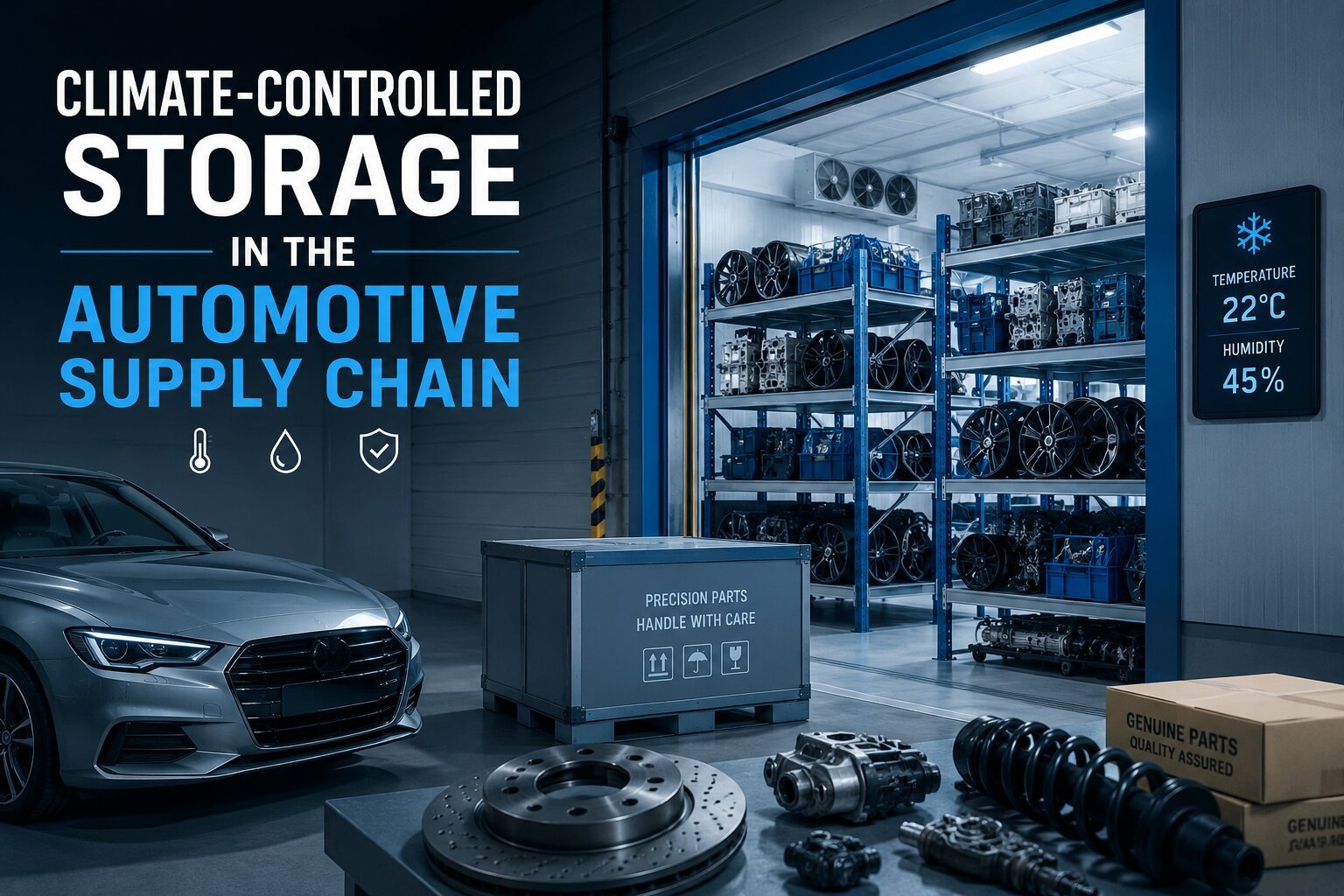
The automotive industry thrives on precision. Every little detail matters, from the tiniest sensor to a fully assembled transmission unit. Each component requires careful handling, and that goes for how manufacturers and logistics providers store them, too. These days, climate-controlled storage is essential in modern automotive supply chains. It safeguards sensitive parts from extreme temperatures, humidity damage, and the risk of costly deterioration.
Why the Automotive Supply Chain Needs Climate-Controlled Storage
Modern vehicles are made up of thousands of parts that are produced in various countries before they come together for final assembly. While these components are in transit or being stored, they encounter real environmental challenges: heat can warp plastic brackets, moisture can corrode electrical connectors, and cold can crack rubber seals. Just one damaged batch can bring production lines to a standstill, delay vehicle launches, and lead to costly recalls.
A climate controlled storage unit takes care of these issues by keeping temperature and humidity levels steady throughout the storage period, no matter what the weather is like outside. In the UK’s famously damp climate, having this kind of environmental control isn’t just a nice-to-have—it’s a crucial part of the supply chain.
Key Automotive Components That Require Climate-Controlled Storage
Not every element feels at home in a laid-back warehouse setting. Some components require more controlled environmental conditions to thrive:
Electronic Control Units (ECUs) and Semiconductors: ECUs play a crucial role in managing everything from fuel injection to driver-assist systems. However, these delicate modules are quite susceptible to humidity and condensation. If moisture gets in, it can damage circuit boards even before the vehicle rolls off the assembly line.
Rubber Seals, Gaskets, and Hoses: Thermal cycling, which is the process of repeatedly exposing rubber components to hot and cold temperatures, can lead to cracking, hardening, and a loss of elasticity. By storing these parts in a climate-controlled environment, you can keep the temperature stable, which greatly helps in extending their shelf life.
Lithium-Ion Battery Packs (EV Components): As electric vehicles continue to surge in popularity, the issue of battery storage has become increasingly important. Lithium-ion batteries tend to wear out more quickly when they’re kept in hot conditions or exposed to extreme cold. That’s why having a climate-controlled storage unit is essential—it helps maintain the batteries within their ideal temperature range, ensuring both their performance and safety are well-protected.
Adhesives, Sealants, and Coatings: When it comes to automotive adhesives, you’ll often find strict temperature storage guidelines right on the packaging. If these products are stored outside their recommended temperature range, they can cure too soon, separate, or even lose their bonding strength. This can lead to production issues down the line.
Painted and Finished Body Panels: Even pre-painted panels require some level of protection. Humidity can lead to surface oxidation and blistering, while heat might dull the finishes before they’re even assembled.
How Climate-Controlled Storage Units Work in Automotive Logistics
Modern climate-controlled storage solutions are equipped with integrated HVAC systems that keep both temperature and humidity in check within a sealed, insulated space. Top providers offer containers that can handle temperature ranges from -40°C to +45°C, with humidity control that’s accurate to within ±0.5°C, a level of precision that the automotive industry really relies on.
Automotive supply chains that span multiple locations gain a major advantage from these portable climate-controlled storage units. Logistics teams can move, scale, and deploy them directly at manufacturing sites, distribution centres, or port holding areas. Rather than pouring resources into permanent cold room construction, logistics managers can position a climate-controlled storage unit exactly where operations demand it, then relocate or expand capacity as the business evolves.
This kind of flexibility is a perfect match for just-in-time (JIT) manufacturing models, where components need to arrive in pristine condition at just the right moment for the production line.
Climate-Controlled Storage and EV Supply Chain Growth
The transition to electric vehicles is transforming the storage needs of the automotive industry on a large scale. Components like battery management systems, power electronics, and thermal management systems require very specific storage conditions. As the production of EVs increases across the UK and Europe, the need for specialised climate-controlled storage is also rising rapidly. Logistics companies that make the investment now in top-notch climate-controlled storage facilities will find themselves becoming the go-to partners for EV manufacturers, a competitive edge that will only become more significant as the production of combustion engines continues to decline.
Choosing the Right Climate-Controlled Storage Unit for Automotive Applications
When selecting a climate-controlled storage unit for automotive supply chain use, consider these factors:
- Temperature range: Ensure the unit covers the full range your specific components require — from deep freeze for certain chemical compounds to moderate cool storage for electronics.
- Humidity control: Look for units with active humidity regulation, not just temperature control.
- Scalability: Choose a provider that offers modular systems you can expand as volumes grow.
- Compliance certifications: Confirm the unit meets UK industry standards and relevant automotive quality frameworks.
- On-site deployment capability: Positioning containerised units directly at your facility reduces handling and transport risk.
Final Thoughts
Climate controlled storage has evolved from a behind-the-scenes necessity in the automotive supply chain to a key player in ensuring quality, compliance, and operational efficiency.
Vehicles are growing more sophisticated. The shift to electric vehicles is accelerating fast. Supply chains that store delicate components in a precisely regulated environment will outperform those that don’t. Climate-controlled storage is what separates the resilient from the vulnerable.
Your storage needs may vary. A single climate-controlled storage unit suits a specific component line. A modular system works better across multiple locations. Either way, the right solution safeguards your parts, keeps production timelines on track, and protects your reputation.
Conrail is your go-to for both standard and custom climate-controlled containers, ready for hire or purchase throughout the UK. Conrail engineers its container solutions to meet the rigorous demands of automotive and industrial supply chains. Temperature ranges span from -40°C to +45°C. Complete humidity control comes as standard.