
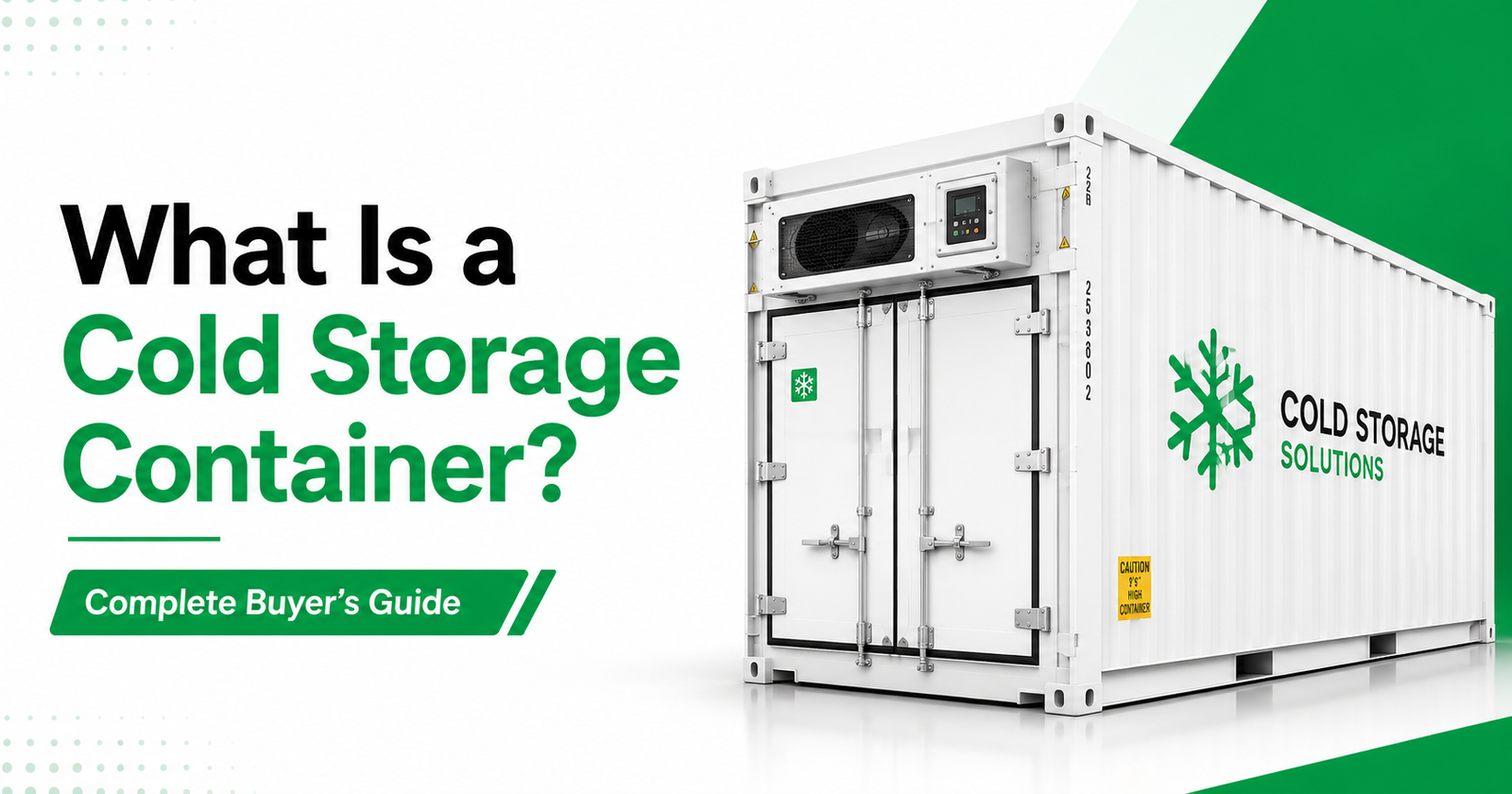
A cold storage container is a fully insulated, temperature-controlled unit – usually built from a converted shipping container – that keeps goods at a set temperature regardless of the weather outside. Businesses use them to store food, pharmaceuticals, flowers, seafood, and other perishable or sensitive products without building a permanent cold room.
If you’ve searched for “refrigerated shipping containers,” “reefer containers for sale,” or “refrigerated container hire,” you’re likely trying to solve one of two problems: you need extra cold storage capacity fast, or you’re comparing renting a refrigerated container against a permanent warehouse solution. This guide answers both.
By the end of this article, you’ll understand exactly what a cold storage container is, how it works, which type suits your industry, and how to choose between buying and renting – so you can make a confident, informed decision.
What Is a Cold Storage Container?
A cold storage container is a repurposed or purpose-built shipping container fitted with refrigeration equipment, insulated panels, and a temperature control system. It functions as a standalone cold room that can be placed almost anywhere – a car park, warehouse yard, farm, event site, or construction compound – without the cost and time of building a fixed cold storage facility.
These units are also known as:
- Refrigerated shipping containers
- Reefer containers
- Portable cold storage
- Mobile cold storage containers
- Cold room containers
Whatever the name, the core idea is the same: a mobile, insulated box that holds a consistent temperature, typically anywhere from -30°C for blast freezing down to +15°C for produce that just needs to stay cool.
How Refrigerated Containers Work
A refrigerated container (or “reefer”) works using the same basic principles as a domestic fridge, scaled up for industrial use.
- Insulated panels – thick, foam-cored walls, floor, and ceiling stop outside heat from entering the unit.
- Refrigeration unit – a compressor-driven system mounted at one end of the container circulates refrigerant to remove heat from inside the box.
- Air circulation – internal fans push cold air through the container, keeping temperature consistent from floor to ceiling.
- Thermostat and controller – a digital control panel lets operators set and monitor the exact target temperature, often with data logging for compliance purposes.
- Power source – most units run on standard three-phase electricity, though diesel generator options exist for off-grid sites.
Because the refrigeration unit is self-contained, a cold storage container can be dropped onto almost any hard-standing surface and be operational within hours of arrival.
Types of Cold Storage Containers
Not all refrigerated containers are built for the same job. Here’s a breakdown of the main types:
| Type | Typical Temperature Range | Common Use |
|---|---|---|
| Chiller container | 0°C to +15°C | Dairy, flowers, beverages, fresh produce |
| Freezer container | -18°C to -25°C | Meat, seafood, ice cream, frozen ready meals |
| Blast freezer container | -30°C to -40°C | Rapid freezing of fresh food, seafood processing |
| Pharmaceutical/vaccine cold storage | +2°C to +8°C (often with data logging) | Medicines, vaccines, clinical trial materials |
| Walk-in cold storage container | Variable | Converted units with shelving for easy staff access |
| Insulated (non-refrigerated) container | Ambient, insulation only | Short-term protection from temperature swings |
20ft vs 40ft Refrigerated Containers
- 20ft refrigerated container – holds roughly 28–30 cubic metres, ideal for smaller businesses, seasonal overflow, or single-site storage.
- 40ft refrigerated container – roughly double the capacity, better suited to larger operations, distribution centres, or multi-pallet storage needs.
If you’re unsure which size fits your volume, our team can help you calculate pallet capacity before you commit to a hire or purchase.
Benefits of Cold Storage Containers
- Fast deployment – operational within days, compared to months for a built cold room extension.
- Flexible capacity – scale up or down with demand, particularly useful around Christmas, summer events, or harvest season.
- Mobility – relocate the unit as your business or site needs change.
- Cost control – avoid large capital investment in permanent refrigeration infrastructure.
- Consistent temperature control – protects stock quality and reduces spoilage-related losses.
- Regulatory compliance – many units support temperature logging required for food safety and pharmaceutical standards.
Applications and Industries That Use Cold Storage Containers
Cold storage containers are used far beyond traditional cold chain logistics. Common applications include:
- Food manufacturers – temporary or permanent storage for raw ingredients and finished products
- Seafood cold storage – fast chilling and freezing at ports and processing sites
- Meat cold storage – carcass chilling, cutting room support, and distribution
- Dairy cold storage – milk, cheese, and yoghurt storage at controlled temperatures
- Pharmaceutical companies – vaccine cold storage containers with strict temperature tolerances
- Construction companies – protecting temperature-sensitive materials on site
- Event organisers – mobile cold rooms for catering, festivals, and weddings
- Logistics and warehousing – overflow capacity or a refrigerated warehouse alternative during peak periods
- Emergency and disaster response – emergency cold storage for medical supplies or food aid
- Retailers and cold chain operators – bridging gaps in the cold chain storage network
Buying vs Renting a Refrigerated Container
One of the most common decisions businesses face is whether to buy a refrigerated container outright or hire one.
When Buying Makes Sense
- You need cold storage permanently or for several years
- You want full control over customisation
- You have the capital budget available upfront
- You’re comparing new refrigerated containers against used refrigerated containers for long-term value
When Renting Makes Sense
- You need temporary cold storage for food, seasonal stock, or a single event
- You want to avoid maintenance and depreciation costs
- You need a fast, low-commitment solution – such as emergency cold storage or temporary freezer storage
- You’re testing new capacity requirements before committing to a purchase
Quick comparison:
| Factor | Buying | Renting |
|---|---|---|
| Upfront cost | High | Low |
| Commitment | Long-term | Flexible, short or long-term |
| Maintenance | Owner’s responsibility | Often included |
| Customisation | Full control | Limited to available stock |
| Best for | Permanent operations | Seasonal, temporary, or trial use |
If you’re searching for “refrigerated container rental,” “cold storage container rental,” or “reefer container hire,” renting is usually the faster and lower-risk route – particularly for businesses that haven’t yet committed to permanent cold storage infrastructure.
Custom Refrigerated Containers
Many businesses need more than a standard reefer box. Custom refrigerated containers can include:
- Internal shelving or racking for walk-in cold storage container use
- Multiple temperature zones within one unit
- Reinforced flooring for heavy pallet loads
- Additional doors for high-traffic access
- Branded external livery for events or retail use
- Enhanced insulation for extreme outdoor conditions
Custom specification is particularly common among pharmaceutical companies and food manufacturers with strict compliance requirements.
Maintenance Tips for Refrigerated Containers
Whether you buy or hire, proper maintenance keeps a cold storage container running efficiently:
- Check door seals regularly – worn seals let warm air in and increase energy costs.
- Keep condenser coils clean – dust and debris reduce cooling efficiency.
- Monitor temperature logs daily – catch fluctuations before they affect stock.
- Avoid overloading – blocked airflow paths create uneven cooling.
- Schedule professional servicing – annual servicing extends the life of the refrigeration unit.
- Defrost freezer units on schedule – ice build-up reduces internal capacity and efficiency.
Common Mistakes to Avoid When Choosing Cold Storage Containers
- Underestimating capacity needs – leaving no room for seasonal peaks
- Ignoring power requirements – some sites need generator backup for uninterrupted power
- Overlooking access needs – forklift access, doorway width, and site levelling matter
- Choosing the wrong temperature range – a chiller unit won’t do the job of a blast freezer
- Not checking compliance requirements – pharmaceutical and food storage often require specific certification and data logging
- Delaying the order – reefer container availability tightens during peak seasons like summer events and Christmas food production
How Much Does a Cold Storage Container Cost?
Costs vary depending on size, temperature range, condition (new vs used), and rental duration. Renting a standard 20ft chiller container is typically far more affordable short-term than purchasing outright, while buying becomes more cost-effective over several years of continuous use. For an accurate quote based on your size, temperature, and location requirements, it’s best to speak with a specialist provider directly rather than rely on generic online estimates.
About Conrail
Conrail has been supplying specialist climate-controlled containers to UK businesses since 2009, with a manufacturing plant in Germany producing standard and bespoke units. The company supplies refrigerated, heated, humidity-controlled, deep-freeze, and hazardous-goods containers, alongside standard storage containers, all available for hire or purchase.
Conrail works with organisations across pharmaceutical, food and ingredients manufacturing, chemicals and processing, oil and petrochemicals, research and development, retail, construction, storage, and logistics sectors. Its containers are used for applications ranging from temperature- and humidity-controlled seed storage and accelerated pharmaceutical curing, to ice cream storage in hot climates and frozen DNA storage – reflecting the breadth of industries that rely on precise, mobile climate control.
As a cost-effective alternative to permanent built cold rooms, Conrail’s systems are fully scalable and designed to meet UK industry standards and compliance regulations, backed by 24/7 customer support with onsite and remote engineering capabilities to minimise downtime risk.
Conrail Wey Court West, Union Rd, Farnham GU9 7PT Tel: 01252 715406 | Email: info@conrail.co.uk Opening Hours: Monday–Saturday, 9am–5pm (Sunday closed)
Frequently Asked Questions
1. What is a cold storage container used for?
It’s used to store temperature-sensitive goods such as food, pharmaceuticals, flowers, and seafood, without needing a fixed cold storage building.
2. What temperature can a refrigerated container reach?
Most units range from around +15°C down to -25°C, with blast freezer containers capable of reaching -30°C to -40°C.
3. Can I rent a refrigerated container short-term?
Yes. Refrigerated container hire is available for short-term needs such as events, seasonal overflow, or emergency storage, as well as longer-term contracts.
4. What’s the difference between a chiller and a freezer container?
A chiller container keeps goods above freezing (typically 0°C to +15°C), while a freezer container maintains sub-zero temperatures for frozen goods.
5. Do refrigerated containers need special power?
Yes, most run on three-phase electricity. Diesel generator power is available for sites without a suitable electrical supply.
6. What size refrigerated container do I need?
It depends on stock volume. A 20ft refrigerated container suits smaller operations, while a 40ft refrigerated container suits larger-scale or distribution needs.
7. Are cold storage containers suitable for pharmaceuticals?
Yes. Pharmaceutical cold storage and vaccine cold storage containers can be fitted with tighter temperature tolerances and data logging for compliance.
8. Can a cold storage container be used outdoors?
Yes, an outdoor cold storage container is designed to withstand weather exposure while maintaining internal temperature control.
9. Is buying or renting a refrigerated container cheaper?
Renting is usually cheaper for short-term or seasonal use; buying is more cost-effective for continuous, long-term operations.
10. How quickly can a refrigerated container be delivered and installed?
Delivery timelines vary by provider and location, but many units can be delivered and operational within days of ordering.
11. Can I get a used refrigerated container instead of a new one?
Yes, used refrigerated containers are widely available and offer a lower-cost alternative to new units, provided they’ve been properly serviced.
12. Do refrigerated containers require groundwork before installation?
A level, load-bearing surface is typically required, along with access for delivery vehicles and, where needed, a power connection point.
13. What industries use mobile cold storage containers most?
Food manufacturing, seafood processing, meat and dairy production, pharmaceuticals, logistics, construction, and event catering are the most common users.
14. Can a cold storage container replace a warehouse cold room?
For many businesses, yes – a refrigerated container serves as a practical refrigerated warehouse alternative, particularly for overflow or temporary capacity.
15. How do I find a refrigerated container provider near me in the UK?
Search for a UK-based specialist like Conrail.co.uk who can advise on size, temperature range, and delivery timelines for your specific site and industry.
Conclusion
A cold storage container is one of the most practical solutions available for businesses that need reliable, flexible temperature-controlled storage – whether that’s a food manufacturer managing seasonal demand, a pharmaceutical company storing vaccines, or an event organiser needing mobile cold storage for a single weekend. Understanding the different types, sizes, and the buy-versus-rent decision puts you in a strong position to choose the right unit for your operation.
Looking for a reliable cold storage container for sale or rental in the UK? Contact the Conrail team today for expert advice and a tailored quotation.