
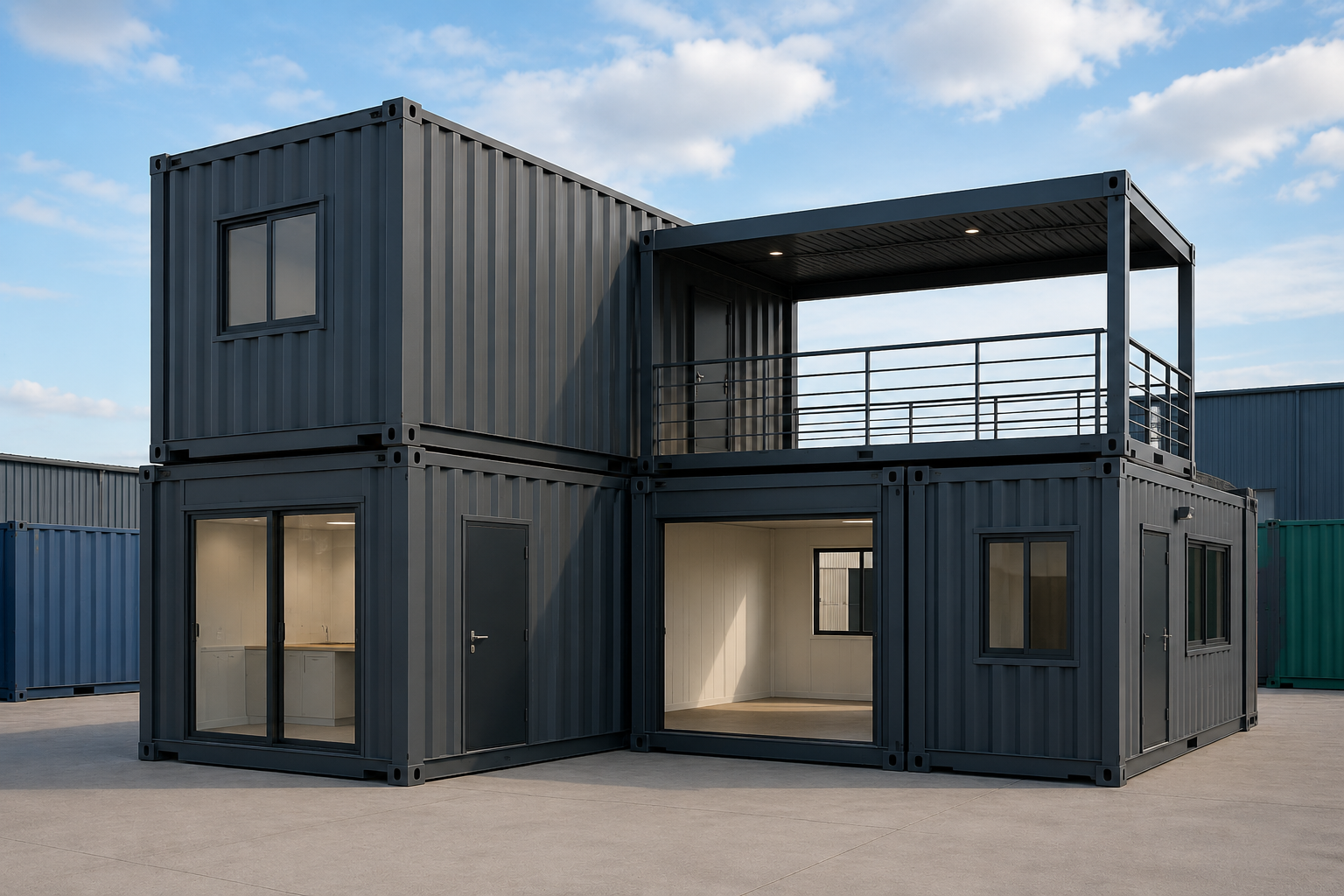
When a standard shipping container isn’t enough – and a full construction project is overkill – bespoke modular container systems sit in the middle: engineered, configurable, and built around exactly what a business needs. They’re increasingly the go-to solution for UK companies that need specialised storage or working space fast, without the cost and delay of bricks and mortar.
But what actually is a bespoke modular container system, how does it differ from a standard container, and how do you know if your business needs one? This guide breaks it down in full.
What Is a Bespoke Modular Container System?
A bespoke modular container system is a custom-engineered storage or working environment built from one or more shipping containers, designed and configured to a client’s exact specification rather than bought off the shelf. Unlike a standard container – which comes in fixed sizes with fixed features – a bespoke modular system can combine multiple units, climate zones, and structural features into a single integrated facility.
The word “modular” is key. Rather than being a single fixed box, these systems are built from individual container modules that can be joined, stacked, or extended – meaning the final structure can be as simple as one adapted unit or as complex as a multi-zone facility spanning several linked containers.
At Conrail, bespoke modular systems are manufactured in Germany to UK compliance standards and can include any feature available across the standard product range: refrigeration, heating, humidity control, deep-freeze capability, or explosion protection. In practice, this means a single bespoke system can house multiple climate zones – for example, a chilled zone and an ambient zone – within one connected footprint.
How Bespoke Modular Systems Differ From Standard Containers
A standard climate-controlled container is a fixed product: a 20ft refrigerated unit, for instance, comes with a defined temperature range, a defined size, and a defined set of features. It’s an effective, proven solution for straightforward requirements.
A bespoke modular system starts from a different question: what does this specific operation actually need? Instead of choosing from a catalogue, the configuration is built around factors like:
- The exact temperature and humidity range required
- The volume and type of goods or activity being housed
- Whether multiple climate zones are needed in one facility
- Site constraints – access, power supply, ground conditions
- Regulatory or compliance requirements specific to the sector
- Future scalability, in case storage needs grow
This is what separates a modular system from a simple container purchase – it’s an engineered solution, not a product pulled from a shelf.
Common Bespoke Modular Configurations
Bespoke systems are typically built around a small number of core configurations, each suited to different scales of requirement:
- Double units – Two containers joined to create a larger continuous space, often used when a single container isn’t large enough but a full mega-unit isn’t necessary.
- Three-fold units – Three linked containers, commonly used to create separate zones within one system – for example, a loading area, a climate-controlled storage zone, and a secondary holding area.
- Mega units – A fully extendable, modular system with almost unlimited scalability, capable of forming a single large climate-controlled facility from multiple joined containers. These are typically used where an operation needs warehouse-scale climate control without warehouse-scale construction.
- Multi-zone systems – Configurations combining different climate requirements in a single footprint – for instance, one section held at deep-freeze temperatures and another at ambient or humidity-controlled conditions, sharing a single facility.
Each of these can incorporate any of the specialist features available across a standard container range, including explosion-proof protection for hazardous goods, precision humidity control, or extreme temperature ranges for pharmaceutical and research applications.
Why Businesses Choose Bespoke Modular Systems Over Traditional Construction
For many UK businesses, the alternative to a modular container system isn’t a different container – it’s a construction project. That comparison is where the case for modular systems becomes clearest.
- Speed of deployment. A modular container system can typically be manufactured and installed in a fraction of the time it takes to plan, gain permissions for, and construct a permanent cold room or specialist facility. For businesses facing urgent capacity needs or seasonal demand spikes, this speed is often the deciding factor.
- Lower capital cost. Compared to permanent construction, modular systems generally represent a significant cost saving, particularly once the cost of civil works, planning, and specialist HVAC installation is factored in.
- Scalability. Because the system is built from individual modules, it can be expanded later – adding further units as the business grows – without the disruption of extending a fixed building.
- Relocation flexibility. Unlike a permanent structure, a modular container system can, in many cases, be relocated if a business changes site or needs to reconfigure its layout.
- Compliance without compromise. A well-engineered bespoke system can meet the same regulatory and industry standards as a purpose-built facility – critical for sectors like pharmaceuticals, food, and chemicals, where compliance isn’t optional.
Industries That Use Bespoke Modular Container Systems
Because these systems are built around specific requirements rather than a fixed product, they’re used across a wide range of sectors, including:
- Pharmaceutical – precision temperature and humidity zones for sensitive products and compliance-driven storage
- Food and ingredients manufacturing – multi-zone cold chain storage from chilled through to deep-freeze
- Chemicals and processing – explosion-proof and hazardous goods configurations
- Research and development – controlled environments for testing, sample storage, and laboratory-adjacent use
- Retail and e-commerce – scalable seasonal storage that can expand with demand
- Construction and logistics – combined storage and site facility configurations
- High-value asset storage – humidity- and temperature-controlled environments for artwork, antiques, and classic vehicles
The common thread across all of these is that a standard, single-feature container doesn’t fully match the requirement – but a full permanent facility would be excessive. Bespoke modular systems fill that gap.
What to Consider Before Specifying a Bespoke Modular System
If you’re exploring whether a bespoke modular container system is right for your business, a few questions are worth answering early:
- What temperature and/or humidity range do you need – and how tightly must it be controlled? Some applications require precision within fractions of a degree; others need a broader working range.
- Do you need more than one climate zone? If different products or processes require different conditions, a multi-zone configuration may be more efficient than separate standalone units.
- What are your site constraints? Power supply, access for delivery, and ground conditions all influence what’s feasible.
- Is there a compliance or regulatory standard you must meet? This is particularly important in pharmaceutical, food, and chemical storage, where documented compliance may be a legal requirement.
- Could your storage needs grow? If so, a modular system designed with future expansion in mind can save significant cost and disruption later.
- Do you need the system permanently, or is this a temporary or seasonal requirement? This will influence whether hire or purchase is the more cost-effective route.
A specialist supplier like Conrail should be able to talk through each of these factors and translate them into a practical specification – rather than simply offering a fixed product and asking you to adapt to it.
How Conrail Approaches Bespoke Modular Container Systems
Conrail has been supplying climate-controlled and specialist containers to UK businesses since 2009, manufacturing at its own facility in Germany to ensure consistent engineering quality and full compliance with UK industry standards.
Every bespoke modular system Conrail builds can incorporate any feature available across its standard container range – climate control, deep-freeze capability, humidity control, or explosion protection – combined into double units, three-fold configurations, or fully extendable mega units, depending on the scale required.
Because requirements vary so significantly between sectors, Conrail doesn’t work from a fixed catalogue for bespoke projects. Instead, systems are specified around the client’s actual operational needs: the product being stored or process being housed, the site it will be deployed to, and the compliance standards that apply. Units are available to hire or buy, and Conrail’s UK team provides 24/7 engineer support – onsite and remote – to protect against downtime once a system is operational.
Frequently Asked Questions
What is the difference between a modular container system and a standard shipping container?
A standard container is a fixed, off-the-shelf product with set dimensions and features. A modular container system is a custom-configured facility, often combining multiple containers and climate zones, designed around a specific operational requirement.
Can a bespoke modular system include more than one temperature zone?
Yes. Multi-zone configurations are common, allowing different sections of the same system to be held at different temperatures or humidity levels within a single connected footprint.
How long does it take to install a bespoke modular container system?
Timelines vary depending on the complexity of the configuration, but modular systems are typically manufactured and deployed considerably faster than an equivalent permanent construction project.
Can bespoke modular systems be expanded later?
Yes. Because these systems are built from individual modules, additional units can generally be added as requirements grow, without needing to rebuild the existing system.
Is a bespoke modular system more expensive than a standard container?
Bespoke configurations involve additional engineering, so they typically cost more than a single standard unit – but remain significantly less expensive than an equivalent permanent structure with built-in climate control.
Which industries most commonly use bespoke modular container systems?
Pharmaceutical, food and ingredients, chemicals, research and development, logistics, and retail are among the most common sectors, though any business needing a non-standard climate-controlled or specialist space can benefit.
Looking to specify a bespoke modular container system for your business? Get in touch with Conrail for a free, no-obligation consultation.