
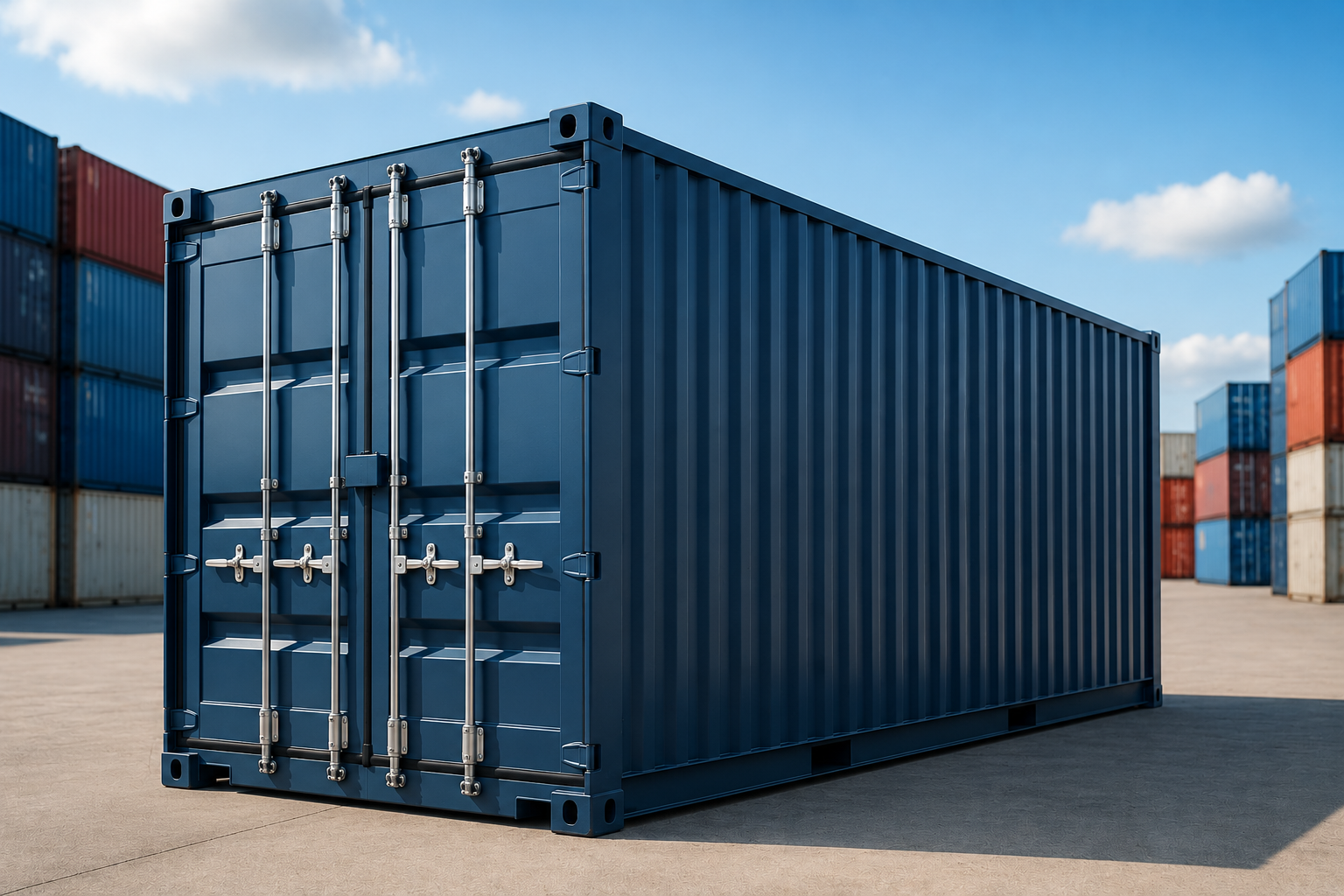
If you’ve spent any time researching containers, you’ve probably noticed most guides read the same way: a table of dimensions, a paragraph on ISO standards, and a sales pitch. This guide is different. It’s written from the perspective of someone who deals with these boxes daily – helping people buy the right one, avoiding the mistakes that cost buyers money, and explaining the bits nobody bothers to mention until you’ve already had a container delivered to the wrong spot.
What is a standard shipping container?
A standard shipping container is a steel box built to the ISO 668 specification, designed to move cargo by ship, rail and road without the goods inside ever being unpacked. “Standard” specifically refers to the general-purpose dry container – a fully enclosed steel box with a single set of double doors at one end, as opposed to specialised variants like open-tops, flat racks, reefers (refrigerated) or tank containers.
When someone in the industry says “standard container,” they mean one of two things: a 20ft or 40ft general-purpose dry box, built to the same external footprint as every other ISO container in the world, so it can be lifted, stacked, and transported on the same cranes, ships, trailers and rail wagons regardless of which country it was built in or which shipping line owns it.
That interchangeability is the entire point. A container built in China in 2015 will stack perfectly on top of one built in Turkey last year, sit on the same chassis, and pass through the same port cranes, because every manufacturer works to the same handful of measurements.
Standard shipping container dimensions
The two dominant sizes are 20ft and 40ft, with a 10ft container also available for smaller storage needs. All three share the same width and height – only the length changes.
20ft standard container:
- External: 6.06m long x 2.44m wide x 2.59m high
- Internal (approx): 5.9m long x 2.35m wide x 2.39m high
- Internal volume: around 33 cubic metres
40ft standard container:
- External: 12.19m long x 2.44m wide x 2.59m high
- Internal (approx): 12m long x 2.35m wide x 2.39m high
- Internal volume: around 67 cubic metres
10ft container:
- External: roughly 3.0m long x 2.44m wide x 2.59m high
- Internal volume: around 15-16 cubic metres
Worth knowing: a “20ft container” isn’t actually 20 feet long. It’s built to 19ft 10.5in, with a strict manufacturing tolerance of just a few millimetres either way. That small gap is deliberate – it’s what allows the twist-lock corner castings to line up precisely when two 20ft boxes are stacked or coupled to form the footprint of a 40ft unit on a ship or chassis.
If you see a High Cube container mentioned alongside standard ones, the difference is height only: a High Cube is 2.89m tall externally (roughly one foot taller than standard), giving about 13% more internal volume on a 40ft box. Everything else – length, width, door position, structural design – stays the same.
Internal and external measurements: why both matter
External dimensions tell you whether a container will physically fit on your driveway, through your gate, or on the lorry delivering it. Internal dimensions tell you whether your cargo, stock, or furniture will actually fit inside once the walls, insulation (if any) and corrugated steel lining eat into the space.
The two numbers are frequently confused in buyer enquiries. A container advertised as “20ft” gives you roughly 33 cubic metres of internal space – not the 40 cubic metres you’d get by simply multiplying the external length, width and height. The steel walls, floor structure and roof bows all take a bite out of the usable interior. If you’re planning to fit racking, a workbench, or specific pallets inside, always work from internal measurements, and check the door opening separately – most standard containers have a door aperture of around 2.34m wide by 2.28m high, which is occasionally narrower than the internal width itself.
Weight and payload
Every container carries three weight figures, usually stamped on a small plate near the door (the CSC plate, more on that below):
- Tare weight – the weight of the empty container itself. Roughly 2.2-2.3 tonnes for a 20ft standard, and 3.7-3.9 tonnes for a 40ft.
- Maximum payload – how much cargo it can legally carry. Around 28 tonnes for a 20ft, and up to 28.8 tonnes for a 40ft standard.
- Maximum gross weight – tare plus payload combined, capped at roughly 30.48 tonnes for most ISO containers regardless of size.
These figures matter for two very different reasons depending on why you’re buying. If you’re shipping cargo, payload determines how much stock you can load before you hit a weight limit that road hauliers or shipping lines will enforce. If you’re using a container for static storage or conversion, tare weight matters more – it tells you what your base, foundation or crane needs to support before you’ve put anything inside it.
Materials and construction
The vast majority of standard shipping containers are built from Corten steel (corrogated weathering steel), chosen because it forms a stable, protective rust layer on its surface that slows further corrosion – useful for a box that spends years being rained on, salt-sprayed, and stacked in open ports.
Floors are typically marine-grade plywood, often treated, bolted to a steel chassis of cross-members strong enough to support a forklift driving in and out fully loaded. The roof and side walls are corrugated for strength (corrugation resists denting and adds rigidity without adding weight), while the four corner posts and castings carry the entire structural load when containers are stacked – a standard container is designed to have up to eight or nine more containers stacked on top of it when empty, which is why the corner posts, not the walls, are the load-bearing elements.
Doors are secured with cam-locking bars and rubber gaskets designed to keep the interior genuinely weatherproof, assuming the seals haven’t degraded.
Common uses
Standard containers turn up in more places than shipping. Typical applications include:
- Freight and export/import cargo – the original and still primary use
- Static on-site storage – trade equipment, stock, tools, seasonal items
- Site security cabins on construction projects
- Conversions – garden rooms, workshops, pop-up retail units, cafés, site offices
- Modular building – stacked and welded together for larger structures, from student accommodation to emergency housing
- Agricultural storage – feed, machinery, tools on farms
Benefits and disadvantages
Benefits:
- Genuinely weatherproof and secure when in good condition, with lockable doors
- Highly durable steel construction, built to survive ocean transit and rough handling
- Widely available in used condition at a range of price points
- Stackable and modular, useful for both storage and structural building projects
- Straightforward to relocate by lorry if you need to move site
Disadvantages:
- Steel conducts heat and cold readily – without insulation, containers get hot in summer and cold in winter, and can suffer condensation
- Heavy – moving one requires a specialist lorry (HIAB or similar) and enough clearance for delivery
- Limited natural light and ventilation in an unmodified box
- Corrosion risk over time if paint or coating is damaged and not maintained
- Base units without windows or additional doors require cutting and reinforcement work if you want to convert them, which adds cost
ISO standards explained
The dimensions, structural requirements and testing standards for shipping containers are set out primarily in ISO 668 (dimensions and ratings) and ISO 1496-1 (specification and testing requirements for general cargo containers). First established in the late 1960s, these standards are why a container built by any manufacturer, anywhere, fits the same handling equipment, ships and chassis worldwide – the interoperability that made modern container shipping possible in the first place.
Every certified shipping container also carries a CSC plate (Convention for Safe Containers), a metal plate fixed near the door stating the container’s identification number, maximum gross weight, tare weight, payload, and – critically – its last structural examination date. If you’re buying a used container for genuine international shipping (rather than static storage), a valid, in-date CSC plate is essential; without one, the container can’t legally be loaded onto a ship. For storage or conversion use, an expired CSC plate isn’t usually a legal problem, but it’s a useful indicator of the container’s age and maintenance history.
New vs used containers
“New” in the container trade almost always means one-trip – a container that has made a single loaded voyage from its country of manufacture (commonly China) before being sold on. It’s not literally brand new off the factory floor untouched, but it’s about as close as most buyers will get, with minimal wear, no dents, and original paintwork.
Used containers are typically graded by condition:
- Cargo-worthy (CW) – structurally sound, wind and watertight, suitable for shipping cargo and CSC-plated
- Wind and watertight (WWT) – sound and dry inside, but may not meet the full cargo-worthy inspection standard, generally the go-to grade for storage
- As-is / AS IS – sold without guarantee of watertightness, cheapest option, best suited to conversion projects where you’re cutting into the structure anyway or don’t mind sealing minor issues yourself
One-trip containers cost more but offer the longest lifespan and cleanest appearance – a sensible choice for conversions where the container itself will be visible, like a garden room or retail unit. Used cargo-worthy containers are the usual choice for straightforward storage where a few cosmetic dents don’t matter.
Buying considerations
Before you commit to an order, it’s worth working through a short checklist:
- Grade – do you need cargo-worthy, or will wind-and-watertight or as-is do the job at a lower price?
- Age – ask for the manufacture date. Containers commonly remain serviceable for 20-25 years with reasonable maintenance, but corrosion, floor condition and door seals vary hugely between individual units of the same age.
- Modifications – if you want windows, extra doors, insulation, electrics or ventilation, decide whether you want these done before delivery or afterwards, and get a written quote covering exactly what’s included.
- Base and ground preparation – most containers need a level, load-bearing base (concrete pads, railway sleepers, or a full slab depending on use) to prevent the frame twisting over time.
- Access for delivery – see the section below; this catches out more buyers than any other single factor.
- Paperwork – for shipping use, confirm CSC certification is current. For storage or conversion, this matters less, but ask anyway as a proxy for overall condition.
Delivery requirements
This is the step most first-time buyers underestimate. Standard containers are delivered by a specialist lorry – usually a hook-lift or a HIAB crane-mounted vehicle – that needs considerably more room to manoeuvre than a typical delivery van.
Before ordering, check:
- Access width and turning space for a large rigid lorry, generally at least 3.5-4m of clear width along the delivery route
- Overhead clearance – trees, power lines, and low bridges are a common problem, particularly for HIAB deliveries that need to lift the container off the truck bed
- Ground firmness along the access route and at the final position – a lorry or crane can sink into soft ground, particularly after rain
- Gradient – steep driveways can prevent a HIAB from safely lowering a container into position
- Final position preparation – the base should be ready and level before the lorry arrives, since repositioning a loaded container after delivery is difficult and often chargeable
If in doubt, most reputable suppliers will ask for photos of the access route and delivery point before confirming a booking, precisely because a failed delivery attempt costs everyone time and money.
Maintenance tips
Containers are low-maintenance compared to most structures, but “low” doesn’t mean “none.” A few habits extend a container’s working life considerably:
- Check door seals annually – perished rubber gaskets are the most common cause of water ingress
- Touch up paintwork promptly where the coating is scratched or chipped, since exposed steel corrodes faster once the protective layer is broken
- Keep the area around the base clear of vegetation and standing water, which accelerates rust at ground level
- Ventilate if the container is used for storage without a dehumidifier – condensation inside a sealed steel box is a common cause of damaged stock, even in a structurally sound unit
- Lubricate door hinges and locking bars periodically to prevent seizing
Common mistakes buyers make
A few issues come up repeatedly:
- Ordering based on external dimensions and then finding stock, racking or furniture doesn’t fit once internal wall thickness and roof bows are accounted for
- Not checking delivery access before ordering, resulting in a failed delivery or an unplanned collection fee
- Assuming a used container is automatically damp-free – always ask about the grade and, where possible, inspect before purchase
- Placing a container directly on soil or an uneven surface, which leads to frame twist and door misalignment within a year or two
- Overlooking planning permission requirements, particularly for containers used commercially, in conservation areas, or intended as a permanent structure rather than temporary storage
When a standard container isn’t the right choice
Standard dry containers aren’t always the answer. Consider alternatives if:
- You need temperature control – a reefer (refrigerated) container is designed for this; a standard box isn’t insulated
- Your cargo is oversized or awkwardly shaped – flat racks or open-top containers handle this better than an enclosed standard box
- You’re planning a habitable building with significant window and door openings – in these cases, the structural cutting required can be extensive enough that a purpose-built modular unit may work out more practical and cost-effective than heavily modifying a shipping container
- You only need storage for a very short period (under 28 days) – in England, this may fall under permitted development rules without needing a full container purchase at all, though local authority confirmation is always worth getting in writing
Specialist container types beyond the standard box
A standard dry container covers most storage and shipping needs, but it’s worth knowing what’s available once your requirements go beyond general-purpose use. UK suppliers typically offer a range of specialist, climate-controlled variants built on the same steel shell:
- Refrigerated Containers – also known as reefers, these are powered, insulated units capable of holding a set temperature (commonly down to around -40°C), used for frozen or chilled goods, pharmaceuticals, and other temperature-sensitive cargo.
- Heated Containers – the opposite use case: insulated units that maintain a warm internal temperature rather than cooling, useful where frost or cold is the risk rather than heat.
- Deep Freeze Containers – a step beyond standard refrigeration, built with heavier insulation and specialised doors to hold very low, constant temperatures for extended periods.
- Humidity-Controlled Containers – regulate both temperature and humidity together, which matters for goods that degrade from moisture rather than temperature alone – seed storage, sensitive electronics, or pharmaceutical curing are typical examples.
- Explosion-Proof Containers – designed for hazardous or flammable materials, typically fitted with passive ventilation, containment trays, and adjustable heating within safe limits.
- Storage Containers – the general-purpose, non-climate-controlled option most people picture when they think “shipping container,” available in a few configurations including side-opening and reinforced steel-floor variants.
- Lithium Battery Storage Containers – a newer, increasingly common category built to fire-safety standards for storing lithium-ion batteries, driven by growth in EV components and renewable energy storage.
- Bespoke Modular Container Systems – multiple containers joined into larger configurations (double units, three-unit blocks, and beyond), used where a single box isn’t enough space but a full building isn’t necessary either.
If your goods are temperature-sensitive, hazardous, or need humidity control, it’s worth speaking to a specialist supplier rather than trying to retrofit a standard container yourself – the insulation, refrigeration units, and safety certifications involved are a different category of build from a standard dry box.
Cost factors
Container pricing varies enough by region, grade, age and current shipping demand that quoting fixed prices here would be misleading. That said, the factors that actually move the price are consistent:
- Grade – as-is is cheapest, cargo-worthy sits in the middle, one-trip commands the highest price
- Size – 40ft containers cost more than 20ft, though not exactly double, since transport and handling costs don’t scale linearly with size
- Age and condition – visible rust, dents, and floor damage all reduce price
- Delivery distance and access difficulty – a HIAB delivery to a tricky rural site costs more than a straightforward drop on a flat, accessible yard
- Modifications – windows, personnel doors, insulation, electrics and painting are typically quoted separately from the base container price
- Regional container availability – prices fluctuate with global shipping demand and container availability at UK ports, so the same container type can vary in price from month to month
For an accurate figure, get quotes from at least two or three suppliers for the same grade and size, since regional stock levels affect price more than most buyers expect.
Practical buying advice
If you’re buying your first container, the process that avoids most problems looks like this: decide what you actually need it for (storage, shipping, or conversion), pick the grade accordingly rather than defaulting to the cheapest option, confirm your site’s delivery access before you order, and check whether planning permission applies to your specific use and location before the container arrives rather than after. A container bought for the wrong grade, delivered to a site that can’t actually accommodate the lorry, is the single most common – and most avoidable – cause of a bad experience.
Frequently Asked Questions
What is the size of a standard shipping container?
The two most common sizes are 20ft (6.06m x 2.44m x 2.59m) and 40ft (12.19m x 2.44m x 2.59m), both built to the same width and height under ISO 668, differing only in length.
What is the difference between a 20ft and 40ft container?
Length and internal volume. A 20ft container holds around 33 cubic metres, a 40ft holds around 67 cubic metres – roughly double, since width and height are identical.
How much does a standard shipping container weigh?
Empty (tare) weight is around 2.2-2.3 tonnes for a 20ft container and around 3.7-3.9 tonnes for a 40ft container.
How much can a standard shipping container carry?
Maximum payload is roughly 28 tonnes for a 20ft container and up to 28.8 tonnes for a 40ft standard container, though the overall gross weight (container plus cargo) is capped at around 30.48 tonnes for most ISO units.
Do I need planning permission for a shipping container in the UK?
It depends on use, location and duration. Temporary placement under 28 days a year, and containers used incidentally to an existing use of the land (agricultural storage, construction site cabins), often don’t need permission. Permanent placement, commercial use, conservation areas, AONBs, and habitable conversions generally do. Always confirm with your local planning authority, since interpretation varies between councils.
Can I live in a shipping container in the UK?
Only with full planning permission and compliance with Building Regulations covering insulation, fire safety, structural integrity and ventilation. Permitted development rights, which cover garden sheds and storage, do not extend to creating a separate dwelling.
What is the difference between cargo-worthy and wind-and-watertight containers?
Cargo-worthy containers pass a full structural inspection and are certified for international shipping. Wind-and-watertight containers are sound and dry but haven’t passed the full cargo-worthy inspection – a common, cost-effective choice for static storage rather than shipping.
What is a one-trip container?
A container that has completed a single loaded voyage from its country of manufacture before being sold. It’s the closest most buyers get to new, with minimal cosmetic wear.
How long does a standard shipping container last?
With reasonable maintenance – particularly keeping paintwork intact and door seals in good condition – a standard container typically remains serviceable for 20-25 years, sometimes longer for units kept dry and off bare soil.
What is a CSC plate and why does it matter?
It’s a metal plate near the container door recording its ID, maximum gross weight, tare weight, and last structural inspection date, required under the Convention for Safe Containers. A valid CSC plate is legally required for international shipping use; for storage or conversion it’s less critical but still a useful indicator of the container’s condition history.
What is a High Cube container?
A container with the same length and width as a standard box but roughly one foot taller (2.89m external height rather than 2.59m), giving extra internal volume – useful for bulky, lightweight cargo or conversions needing extra headroom.
Can I put a shipping container next to my house?
Usually yes for storage purposes, subject to permitted development rules on height, position relative to the principal elevation, and total garden coverage. Position, visibility from the street, and whether the land is in a conservation area all affect whether permission is needed.
Do I need a concrete base for a shipping container?
Not always, but some form of level, load-bearing base – concrete pads, sleepers, or a full slab – is strongly recommended. Placing a container directly on soft or uneven ground commonly causes the frame to twist, which misaligns the doors within a year or two.
What’s the difference between a standard container and a High Cube for storage?
Footprint is identical; the High Cube simply offers extra headroom and roughly 13% more internal volume on a 40ft unit, useful if you’re storing tall items or plan to add internal shelving.
Is a used shipping container a good buy for a garden conversion?
Often yes, particularly one-trip or cargo-worthy grades, since the structure is durable and requires no additional cladding. As-is containers can also work but usually need more remedial work on seals, paintwork and floor condition before conversion.
Ready to Buy a Shipping Container?
Whether you need a standard storage container, refrigerated unit, heated container or a bespoke solution, our experts are here to help. We’ll recommend the right container for your requirements and provide a competitive, no-obligation quote.
✅ Free Expert Advice
✅ Nationwide UK Delivery
✅ New & Used Containers Available