
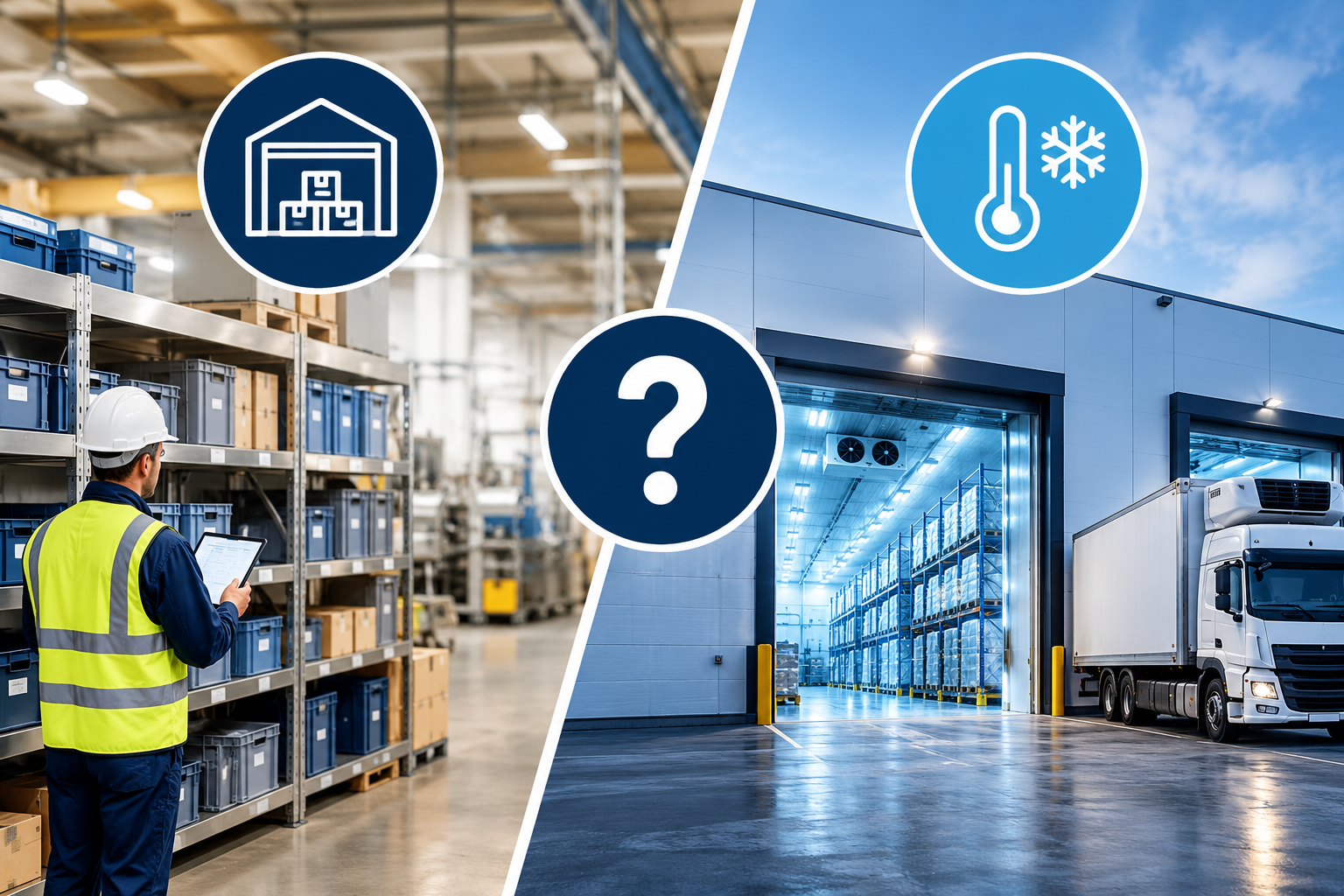
When your products, materials or equipment need to be kept within a specific temperature range, choosing the right storage solution is about much more than finding additional space.
For many businesses, the real question is whether on-site temperature controlled storage or off-site temperature controlled storage makes more sense.
Both options can provide protection from temperature fluctuations and environmental conditions. However, they offer very different advantages when it comes to accessibility, cost, scalability, security and day-to-day operations.
For businesses handling pharmaceuticals, food and beverages, chemicals, electronics, research materials, cosmetics, specialist equipment or other temperature-sensitive products, making the right decision can have a direct impact on product quality and operational efficiency.
So, which option is best?
The answer depends on what you are storing, how often you need access to it, how much capacity you require and where that storage needs to be located.
What Is Temperature Controlled Storage?
Temperature controlled storage is designed to maintain a defined internal temperature rather than allowing stored goods to simply follow external weather conditions.
Standard storage can be affected by seasonal changes, heat, cold and temperature fluctuations. A temperature controlled environment actively manages the internal conditions to provide a more suitable environment for temperature-sensitive products and materials.
Depending on the application, businesses may require:
- Refrigerated storage
- Heated storage
- Ambient temperature control
- Deep-freeze storage
- Temperature and humidity controlled storage
- Bespoke environmental conditions
The correct solution depends on the specific requirements of the goods being stored.
For example, Conrail supplies temperature controlled containers capable of supporting applications ranging from refrigerated and heated storage to deep-freeze and humidity-controlled environments.
What Is On-Site Temperature Controlled Storage?
On-site temperature controlled storage means placing the storage solution directly at your own premises.
Rather than transporting temperature-sensitive goods to an external warehouse or storage facility, a temperature controlled storage unit or container can be positioned where your business already operates.
This can be particularly useful for:
- Manufacturing facilities
- Warehouses
- Distribution centres
- Pharmaceutical businesses
- Food and beverage companies
- Research facilities
- Construction sites
- Industrial facilities
- Retail operations
- Agricultural businesses
One of the biggest advantages is simple: the storage is where you need it.
Products can be moved directly from production or receiving areas into controlled storage, reducing unnecessary handling and transportation.
What Is Off-Site Temperature Controlled Storage?
Off-site temperature controlled storage means moving your products, equipment or materials to a separate storage facility.
This could be a specialist warehouse, cold store, logistics facility or commercial storage provider offering temperature controlled storage units.
For businesses without suitable space at their own premises, this can be an attractive option.
Off-site storage may also make sense when:
- Your existing premises are already full
- You do not have suitable hardstanding
- You need a large amount of additional capacity
- You want another business to manage the storage environment
- Your storage requirements are temporary
- You need access to an established logistics network
However, there is an important consideration: your goods are no longer stored where your operation takes place.
That can introduce additional transportation, handling and logistics requirements.
On-Site vs Off-Site Temperature Controlled Storage
There is no universal answer because the right choice depends on your operation.
Here are the key factors to consider.
1. Accessibility
For many businesses, access is one of the biggest advantages of on-site storage.
With an on-site temperature controlled storage unit, your stock or equipment can remain close to your production line, warehouse, laboratory or loading area.
This can make it easier to:
- Load and unload goods
- Retrieve products quickly
- Manage stock
- Respond to urgent orders
- Reduce internal transportation
- Keep temperature-sensitive products within your operational environment
Off-site storage requires goods to be transported between your premises and the storage facility.
That may not be a problem for businesses with planned deliveries, but it can become inconvenient when frequent access is required.
Best for accessibility: On-site storage
If your team needs regular or immediate access to temperature-sensitive stock, on-site storage can offer a major operational advantage.
2. Available Space
The biggest argument for off-site storage is often that there simply isn’t enough room on the company’s premises.
An existing warehouse may already be operating close to capacity. Building an extension may be expensive, time-consuming or impractical.
This is where a temperature controlled storage container can provide an alternative.
Rather than committing to a permanent building project, businesses can add controlled storage capacity where suitable space is available.
Conrail’s modular container systems can be configured for different applications and layouts, providing businesses with an alternative to constructing permanent temperature controlled facilities.
Best for limited internal space: Off-site or additional on-site container storage
The important point is that “on-site” does not necessarily mean building another room inside your premises.
A purpose-built temperature controlled container can provide additional capacity externally while keeping the goods at your own location.
3. Cost
Cost comparisons should go beyond the rental price of a storage unit.
With off-site storage, businesses may need to consider:
- Storage fees
- Collection and delivery charges
- Transportation
- Loading and unloading
- Additional handling
- Access charges
- Logistics administration
With on-site storage, there may be costs associated with:
- Unit purchase or hire
- Site preparation
- Electricity
- Installation
- Maintenance
- Monitoring
The most cost-effective solution depends on the volume and value of the goods, how frequently they move and how long they need to be stored.
For a business requiring additional capacity for several months, hiring a temperature controlled container may be more practical than committing to a major permanent construction project.
For a business with relatively low volumes and no suitable space, off-site storage may make more financial sense.
4. Scalability
Business requirements rarely stay the same.
A manufacturer may need additional capacity during a production increase. A retailer may need more storage before a seasonal sales period. A pharmaceutical company may require additional controlled space for a new product or project.
This makes scalability an important consideration.
Traditional buildings can be expensive and slow to expand.
Temperature controlled storage containers offer a more flexible approach because additional units can potentially be added as requirements change.
This is particularly useful for businesses experiencing:
- Seasonal demand
- Temporary projects
- Business growth
- Supply chain disruption
- Production increases
- New product launches
- Temporary warehouse shortages
5. Temperature and Humidity Requirements
Not every temperature-sensitive product requires the same environment.
Some applications require simple temperature regulation, while others require very precise temperature and humidity control.
For example, Conrail provides humidity-controlled containers with adjustable temperature ranges and humidity control for applications including pharmaceutical, medical, chemical and automotive testing environments.
This is an important distinction when comparing storage providers.
Don’t simply ask:
“Is the storage temperature controlled?”
Ask:
“Can the storage environment maintain the specific conditions my products require?”
You should consider:
- Required temperature range
- Temperature tolerance
- Humidity requirements
- Monitoring
- Alarm systems
- Insulation
- Air circulation
- Power requirements
- Access requirements
The right specification matters far more than simply choosing a unit described as “temperature controlled.”
When Is On-Site Temperature Controlled Storage the Better Choice?
On-site storage is particularly attractive when the storage environment needs to form part of your normal operation.
Consider on-site temperature controlled storage if:
You need frequent access
If employees regularly need to retrieve products or materials, keeping them on your premises can simplify operations.
Your products move directly from production into storage
On-site storage can reduce unnecessary transportation between production and an external storage facility.
You need temporary additional capacity
A temperature controlled container can provide additional storage without requiring a permanent building extension.
Your business is growing
Additional units can provide a way to increase storage capacity alongside operational growth.
You operate at a remote or industrial site
For certain applications, bringing temperature controlled storage directly to the site may be considerably more practical than transporting materials to an external facility.
When Is Off-Site Temperature Controlled Storage the Better Choice?
Off-site storage can make sense when your premises simply cannot accommodate the required equipment or when you want to outsource part of your storage operation.
It may be appropriate if:
- You have no suitable space available
- You cannot install additional equipment at your premises
- You require significant long-term capacity
- You have limited access to power
- You prefer storage and logistics to be managed externally
- Your storage requirements are concentrated in another location
For some businesses, off-site storage is the simplest solution.
For others, the additional transportation and handling make it less efficient than having temperature controlled storage directly on their premises.
Could a Temperature Controlled Container Be the Middle Ground?
For many businesses, the choice does not have to be simply “our building” or “an external warehouse.”
A temperature controlled container can provide a third option.
Instead of constructing a permanent temperature controlled room or sending products to an off-site facility, a business can introduce controlled storage capacity directly at its own site.
This can provide the benefits of:
On-site access + controlled environmental conditions + flexible capacity.
Depending on the application, businesses can consider refrigerated containers, deep-freeze containers, heated containers or humidity-controlled systems.
This approach can be particularly useful where storage requirements are temporary, seasonal or expected to change.
Questions to Ask Before Choosing Temperature Controlled Storage
Before committing to a storage solution, consider these questions:
1. What temperature range do your products require?
Don’t choose a storage solution based solely on the phrase “temperature controlled.” Establish the actual required operating range.
2. Do you need humidity control?
Some products are affected by moisture as well as temperature. In these situations, climate controlled or humidity-controlled storage may be more appropriate.
3. How frequently will you access the goods?
Frequent access can strongly favour an on-site solution.
4. How much storage capacity do you need?
Consider both your current requirements and expected growth.
5. How long will you need the storage?
Temporary requirements can make a hired container particularly attractive, while long-term requirements may justify a different solution.
6. Where are the goods being produced or received?
If goods are already arriving at your premises, on-site storage could reduce unnecessary transport.
7. What happens if your storage requirements change?
Look for a solution that can scale with your business rather than locking you into capacity you may not need later.
On-Site or Off-Site? Start With Your Operation
The right temperature controlled storage solution should fit around your business rather than forcing your business to adapt around the storage.
For companies that need immediate access, operate from industrial sites or require additional capacity close to production, on-site temperature controlled storage can provide significant operational advantages.
For businesses without suitable space or those looking to outsource their storage requirements, off-site temperature controlled storage may be the more practical choice.
And where businesses need additional flexibility, a temperature controlled container can provide a useful middle ground.
The key is to look beyond the simple question of where the storage is located.
Consider temperature requirements, humidity, accessibility, capacity, scalability, logistics and total operating cost before making a decision.
Need Temperature Controlled Storage at Your Site?
Conrail supplies a range of temperature controlled storage units and climate controlled containers for commercial and industrial applications across the UK.
Solutions include refrigerated containers, deep-freeze containers, heated containers, humidity-controlled containers and bespoke modular systems.
Whether you need additional capacity for a short-term project, seasonal demand or a long-term operational requirement, the right system can be designed around your specific requirements.
Talk to Conrail about your temperature controlled storage requirements and find out which solution is right for your site.