
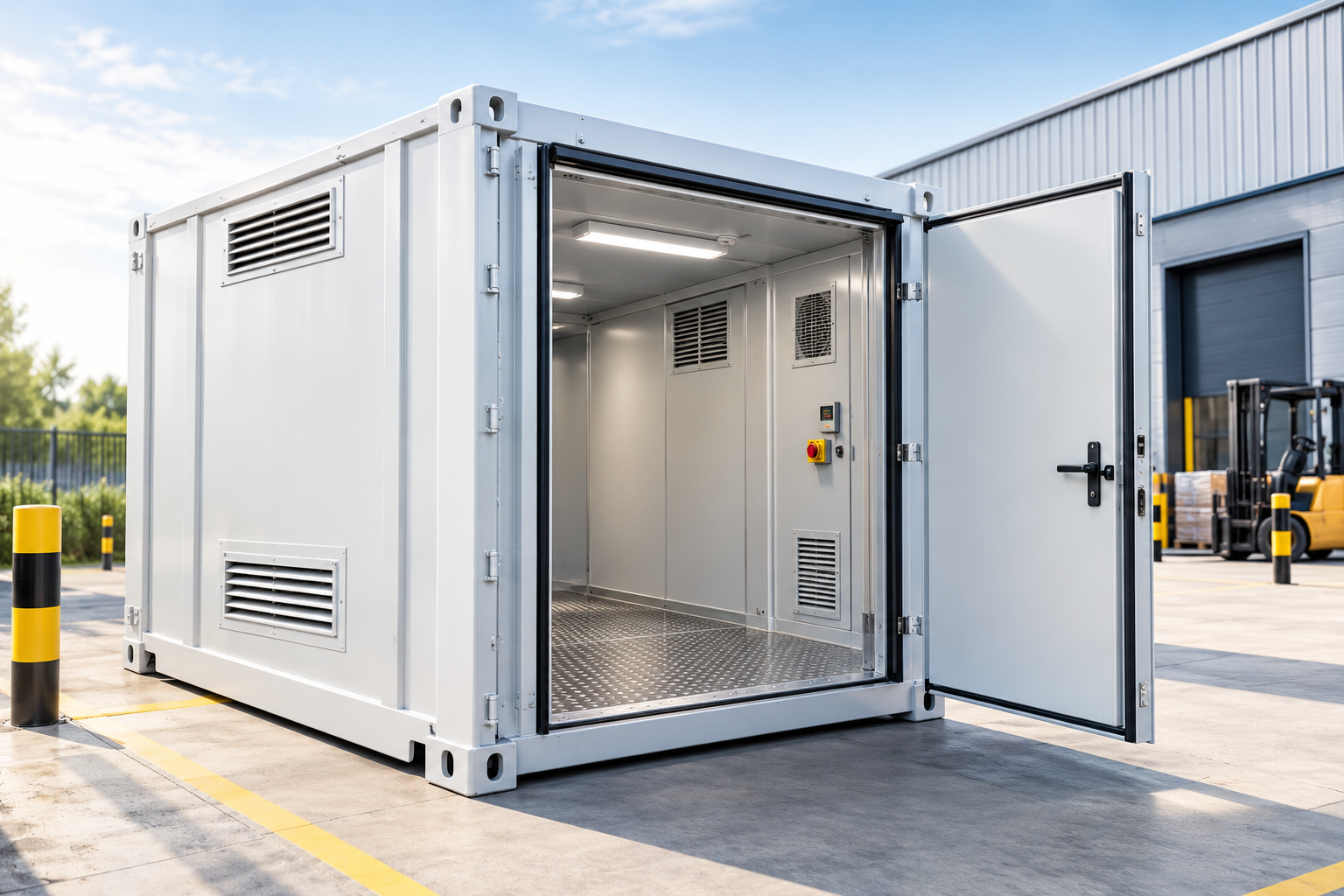
Lithium battery storage for warehouses is becoming an increasingly important consideration for businesses operating electric forklift trucks, automated handling equipment, power tools and other battery-powered machinery. As warehouses become more reliant on lithium-ion technology, having suitable storage arrangements is essential for managing fire risks, making efficient use of space and maintaining safe working practices.
Although lithium-ion batteries offer advantages such as high energy density and convenient recharging, they can present serious hazards if damaged, defective, incorrectly charged or stored in unsuitable conditions. A battery failure can lead to thermal runaway, fire and the release of hazardous gases, potentially affecting employees, equipment, stock and business continuity.
For warehouse managers, logistics operators and facilities teams, the challenge is to establish a storage strategy that supports day-to-day operations without overlooking safety.
This guide explores the key considerations for warehouse lithium battery storage, including risk assessment, fire protection, space planning, relevant UK legislation and the role of specialist storage containers.
Why Is Lithium Battery Storage Important in Warehouses?
Lithium-ion batteries are used across many commercial environments, from handheld scanners and power tools to electric forklifts and industrial equipment. Warehouses may also hold replacement batteries, spare battery packs and batteries awaiting inspection or disposal.
As quantities increase, businesses need clearly defined procedures for storing, handling, inspecting and charging batteries. Effective lithium-ion battery safety starts with understanding the batteries on site and the risks associated with their intended use.
One significant hazard is thermal runaway, an uncontrollable reaction in which a battery cell generates heat and may trigger further failures. This can result in fire, smoke, hazardous gases and damage to surrounding materials.
Potential contributing factors include:
- Physical damage from impacts, crushing or dropping.
- Internal battery faults or manufacturing defects.
- Incorrect charging or incompatible charging equipment.
- Exposure to temperatures outside the manufacturer’s recommended range.
- Electrical faults, short circuits or inappropriate handling.
- Poor management of damaged or defective batteries.
Effective lithium battery fire safety requires businesses to assess these hazards before deciding where and how batteries should be stored.
A suitable storage strategy can help businesses manage risks, maintain organised operations and reduce the likelihood of avoidable disruption. It should form part of the wider workplace fire risk assessment rather than being treated as a standalone purchasing decision.
1. Assess Your Lithium Battery Storage Requirements
Before investing in lithium battery storage solutions, warehouse operators should establish what needs to be stored, in what quantities and under which conditions.
Different batteries have different characteristics. A small collection of power-tool batteries presents different challenges from high-capacity forklift batteries or large industrial battery packs.
Start by considering the following factors.
Battery type and quantity
Record the battery chemistry, dimensions, capacity, quantity and intended application. Consider whether batteries are new, in use, awaiting inspection or being retained for disposal.
Forecast future requirements as well. An expanding electric forklift fleet or new automated handling system may increase demand for dedicated storage capacity.
Battery condition
Establish a procedure for identifying batteries that are swollen, leaking, damaged, unusually hot or otherwise defective.
These batteries should not simply be returned to ordinary storage. Staff should follow an established isolation and escalation procedure informed by manufacturer instructions and competent safety advice.
Storage and charging activities
Storing batteries and charging them are separate activities that can introduce different hazards.
Where charging takes place, assess the charging equipment, electrical installation, heat generation, ventilation and potential consequences of a battery failure. Do not assume that a storage container is automatically suitable for charging unless its specification explicitly supports that use.
Manufacturer recommendations
Follow the manufacturer’s instructions for storage temperature, charging, state of charge, inspection and handling.
These checks establish the foundation for safe lithium battery storage and help determine the most appropriate storage arrangements for the site.
2. Improve Warehouse Space Without Compromising Safety
Warehouse floor space is valuable. Storage areas must support efficient picking, movement, handling and access while keeping employees and equipment safe.
However, placing batteries wherever space is available can create problems if the location has not been assessed for the associated hazards.
Establish a designated storage area
A dedicated battery storage area can help businesses control access, organise stock and introduce consistent inspection procedures.
The location should be assessed for its proximity to combustible materials, occupied areas, escape routes, vehicle movements and other potential hazards.
The required separation and protection measures will depend on the battery type, quantity, building layout and risk assessment.
Consider external storage
For businesses holding larger quantities of batteries, external storage may offer an alternative to using valuable internal warehouse space.
Specialist industrial battery storage containers can provide a dedicated location for battery storage, subject to the product specification and site assessment. This can help preserve internal space for stock, equipment and day-to-day warehouse activities.
External placement does not automatically eliminate fire risks. The container’s location, access, weather protection, separation from nearby buildings and potential impact on surrounding operations must all be considered.
Maintain clear access
Storage arrangements should not obstruct emergency exits, pedestrian routes, vehicle routes or access to safety equipment.
A well-planned approach to warehouse lithium battery storage can improve organisation while ensuring that safety remains central to the layout.
3. Manage Fire Risks and Thermal Runaway
Lithium battery fire safety should be a central consideration when designing storage arrangements. A battery failure can escalate quickly, and heat from one battery may affect nearby cells, packs or combustible materials.
Businesses should evaluate the likelihood of an incident and the potential consequences before deciding which protective measures are appropriate.
Important considerations include:
- Fire risk assessment: Identify battery-related hazards and evaluate the potential impact on people, buildings and operations.
- Separation: Determine suitable distances or physical barriers between batteries, combustible materials and other areas.
- Detection: Assess whether smoke, heat, gas or other detection technologies are appropriate for the identified risks.
- Ventilation: Consider whether battery failure could release gases that require specific ventilation or gas-management measures.
- Emergency planning: Establish procedures for raising alarms, evacuating staff and contacting the emergency services.
- Inspection and maintenance: Ensure relevant protective systems are inspected, tested and maintained.
These measures should be selected through a site-specific assessment rather than assuming that one standard configuration will suit every warehouse.
Businesses should also review their existing lithium-ion battery safety procedures when increasing battery quantities, introducing new equipment or changing how batteries are stored.
4. What Should You Look for in Lithium Battery Storage Containers?
For businesses that require dedicated storage capacity, purpose-designed lithium battery storage containers may offer a practical option.
Unlike ordinary shipping containers, specialist solutions can be specified around the hazards associated with lithium-ion batteries. However, features and performance vary between products, so it is important to evaluate the actual specification.
Fire-rated construction
Ask the supplier to explain the container’s fire performance, relevant test evidence and intended application.
A fire rating should be understood in context. It does not guarantee that a container will contain every possible battery fire or meet every requirement of a particular site.
Ventilation and gas detection
Depending on the application, ventilation and gas detection may be important parts of the safety design.
The specification should consider the gases that could be released during battery failure, how they might accumulate and whether additional monitoring or ventilation is needed.
Fire detection and suppression
Ask which detection and suppression systems are available and whether they are appropriate for the batteries being stored.
The final configuration should reflect the battery chemistry, quantities, stored energy and wider site fire strategy. No single system should be assumed suitable for every battery application.
Pressure relief
Some battery failure scenarios can involve rapid gas release and pressure build-up. Ask whether pressure-relief measures are incorporated where required by the risk assessment and design.
Capacity, layout and security
Consider battery dimensions, weight, quantities, access requirements and any shelving or handling equipment needed.
The internal layout should support safe handling and inspection without overcrowding. Security measures should also be appropriate for the value of the batteries and the site’s operating arrangements.
When comparing industrial battery storage containers, businesses should look beyond capacity and price to understand how the complete specification addresses their operational risks.
5. Lithium Battery Storage Compliance UK: What Businesses Should Consider
Lithium battery storage compliance UK requirements depend on the activity, location, battery quantities and risks involved. Businesses should not assume that purchasing a specialist container alone makes their storage arrangements compliant.
Relevant legislation and guidance may include the following.
Health and Safety at Work etc. Act 1974
Employers have duties to protect employees and others affected by their work activities. Battery storage, handling and charging risks should be identified and managed appropriately.
Regulatory Reform (Fire Safety) Order 2005
In England and Wales, the responsible person must ensure that a suitable and sufficient fire risk assessment is carried out and that appropriate fire safety measures are maintained. Different legislation applies in Scotland and Northern Ireland.
Dangerous Substances and Explosive Atmospheres Regulations 2002 (DSEAR)
DSEAR may apply where dangerous substances or explosive atmospheres create relevant risks. Businesses should assess whether gases or vapours associated with their activities could create fire or explosion hazards and implement appropriate controls where required.
Electricity at Work Regulations 1989
Where batteries are charged or electrical equipment is used, relevant electrical risks must be managed through suitable installation, operation and maintenance arrangements.
Insurance and site-specific requirements
Insurers may specify additional conditions concerning battery quantities, storage locations, separation, detection or suppression.
Businesses should consult their insurer and relevant competent advisers when planning new storage arrangements or making significant changes.
For further information, consult the Health and Safety Executive’s battery energy storage guidance. This guidance focuses on battery energy storage systems, so businesses should also seek guidance appropriate to their specific warehouse application.
A considered approach to lithium battery storage compliance UK should begin with a documented assessment of the actual workplace, rather than a generic checklist alone.
6. Establish Safe Handling and Inspection Procedures
Even the best-designed storage facility depends on consistent working practices.
Warehouse operators should document how batteries are received, moved, stored, inspected and removed. Staff should understand what to do when a battery is damaged or shows signs of overheating.
Effective procedures for safe lithium battery storage should cover:
- Staff training appropriate to the batteries and equipment on site.
- Inspection for visible damage and other warning signs.
- Protection against short circuits and physical impacts.
- Compliance with manufacturer instructions for storage and charging.
- Reporting and escalation of damaged or defective batteries.
- Suitable arrangements for isolation, specialist assessment and disposal.
- Emergency response and incident reporting.
Damaged batteries should not be placed in general storage without an appropriate assessment and procedure.
Regular reviews are also important. Changes in battery quantities, warehouse layout, charging practices or equipment can introduce new risks and may require the existing assessment to be updated.
These measures support lithium-ion battery safety while helping businesses maintain consistent standards across their operations.
7. Lithium Battery Storage Solutions: Indoor or Outdoor?
Choosing between indoor and outdoor storage depends on the site’s operational needs and risk assessment.
Indoor storage may provide convenient access for smaller quantities, but the location must be assessed for fire risks, escape routes, surrounding stock, charging activities and the building’s existing fire strategy.
Outdoor storage may help separate batteries from routine warehouse activities and free up internal floor space. However, businesses must consider positioning, weather protection, security, access and the potential consequences of a battery incident for nearby buildings.
For larger storage requirements, specialist lithium battery storage solutions may include dedicated external containers configured for the intended application.
Conrail supplies lithium battery storage containers for hire and purchase. Depending on the selected specification, options may include fire-rated internal linings, mechanical ventilation, pressure-relief panels and integrated spill containment. Gas detection and automated fire suppression may also be available, subject to the requirements of the application.
Businesses should confirm the available features, intended use and installation requirements directly with Conrail before making a decision.
8. Lithium Battery Storage Container Hire or Purchase?
Once the storage requirements have been established, businesses can compare lithium battery storage container hire with purchasing a permanent solution.
When hiring may be suitable
Lithium battery storage container hire may suit temporary projects, seasonal increases in demand or businesses that need additional storage while changing their operations.
Hiring can also provide flexibility where the long-term quantity of batteries or the required storage capacity remains uncertain.
When purchasing may be suitable
Purchasing may be more appropriate when battery storage is a permanent part of warehouse operations and the required capacity is expected to remain relatively stable.
A purchased unit can be selected around the intended application, subject to the available design, site requirements and necessary approvals.
When comparing options, consider the total cost, expected duration of use, delivery, positioning, maintenance responsibilities and future flexibility.
Conrail offers lithium battery storage container hire and purchase options, allowing businesses to explore an arrangement suited to their operational needs.
The right choice should be based on the site’s requirements, not simply the lowest initial cost.
9. Choosing the Right Commercial Battery Storage Solutions
Selecting suitable commercial battery storage solutions involves balancing safety, capacity, accessibility and cost.
Before requesting a quotation, businesses should establish:
- The type and quantity of batteries to be stored.
- Whether batteries will be stored only or charged on site.
- The storage capacity and internal layout required.
- The fire protection, ventilation and monitoring measures identified by the risk assessment.
- Whether indoor or outdoor placement is appropriate.
- Any insurer, planning, building or site-specific requirements.
- Whether hiring or purchasing offers the best long-term value.
This information helps suppliers understand the intended application and recommend an appropriate specification.
For warehouses reviewing their existing lithium battery storage requirements, a planned approach can also identify opportunities to improve organisation, preserve floor space and establish more consistent operating procedures.
Conclusion: Plan Safer, More Efficient Warehouse Battery Storage
Lithium batteries are becoming an essential part of modern warehouse operations, but their storage needs careful planning. Businesses must consider battery condition, fire risks, handling procedures, available space and the legal obligations relevant to their activities.
A structured approach to lithium battery storage for warehouses can help businesses make informed decisions about storage capacity, protective measures and operational requirements.
For some operations, a dedicated storage area may be sufficient. For others, specialist lithium battery storage containers may provide a practical way to create additional capacity while separating batteries from everyday warehouse activities.
Conrail supplies specialist battery storage containers for hire and purchase, with options that can be considered according to the needs of the site and its risk assessment.
Looking for lithium battery storage solutions for your warehouse? Visit Conrail’s lithium battery storage containers page to explore the available options, or contact the team to discuss your requirements.
Frequently Asked Questions
How should lithium batteries be stored in a warehouse?
Lithium battery storage for warehouses should follow manufacturer instructions and a site-specific risk assessment. Businesses should consider battery condition, quantities, temperature, charging activities, fire risks, separation, access and emergency procedures.
Do warehouses need specialist lithium battery storage containers?
Not every warehouse requires the same solution. Depending on the quantities and risks involved, a designated storage area, specialist cabinet, dedicated room or external container may be appropriate. The decision should be informed by the risk assessment and relevant professional advice.
What are the main lithium battery fire safety considerations?
Lithium battery fire safety involves assessing thermal runaway risks, identifying suitable separation, selecting appropriate detection and protective systems, inspecting batteries and preparing emergency procedures. The exact measures depend on the application and site conditions.
What does lithium battery storage compliance UK involve?
Lithium battery storage compliance UK involves identifying the legislation and guidance relevant to the workplace, assessing risks and implementing suitable controls. Requirements vary according to the activities and circumstances, so businesses should seek competent advice where necessary.
Is lithium battery storage container hire available?
Yes. Lithium battery storage container hire can be an option for temporary projects or changing storage requirements. Conrail offers containers for hire and purchase, subject to availability and the selected specification.
How can businesses improve warehouse lithium battery storage?
Businesses can review battery quantities, designate suitable storage areas, maintain clear access, introduce inspection procedures and assess whether specialist storage facilities are appropriate. Regular reviews help ensure warehouse lithium battery storage continues to meet operational and safety needs.