
Introduction
Businesses that handle flammable gases, vapours or mists must understand how explosive atmospheres can develop in their workplaces. The ATEX Zone 1 vs Zone 2 classification helps organisations identify hazardous areas and select suitable equipment to control ignition risks.
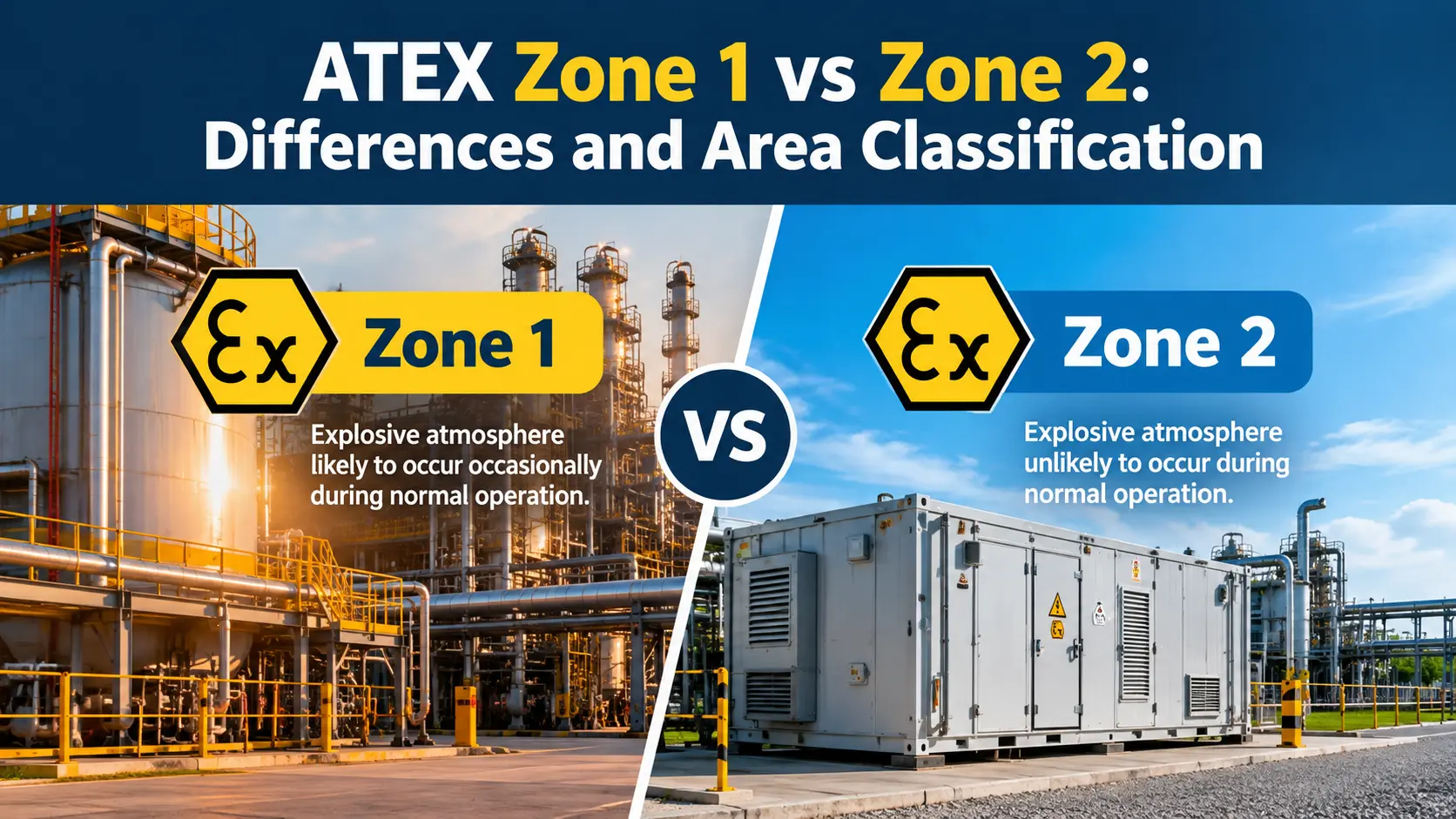
Zone 1 describes an area where an explosive atmosphere may occur occasionally during normal operation. Zone 2 describes an area where an explosive atmosphere is unlikely to occur during normal operation and, if it does, will persist only briefly.
For UK businesses, understanding these differences supports safer operations and more informed equipment choices. It also helps organisations assess specialist solutions, such as explosion proof containers, for suitable storage and industrial applications.
What Is ATEX Zone 1?
ATEX Zone 1 describes an area where an explosive atmosphere containing air mixed with flammable gas, vapour or mist is likely to occur occasionally during normal operation.
Routine industrial activities can release flammable substances and create hazardous conditions. For example, solvent transfer, chemical filling and certain fuel-handling operations may create Zone 1 areas when the site’s risk assessment identifies a corresponding likelihood of an explosive atmosphere.
The classification depends on the substance, release frequency, operating conditions and ventilation. Businesses should therefore assess each location individually instead of assuming that every chemical-handling area requires Zone 1 classification.
Equipment Requirements for ATEX Zone 1
Businesses must select equipment that provides suitable protection against ignition under the conditions identified in their hazardous area assessment. Equipment for gas atmospheres in Zone 1 generally falls within ATEX Equipment Category 2G or 1G, subject to the applicable requirements.
Category 2G equipment provides a high level of protection for areas where explosive atmospheres may occur occasionally. Category 1G equipment provides a very high level of protection for areas where explosive atmospheres may occur continuously, frequently or for long periods.
When selecting equipment, businesses should check the gas group, temperature class, protection concept and manufacturer’s instructions. They should also assess motors, sensors, control panels and other components that could introduce ignition sources.
What Is ATEX Zone 2?
ATEX Zone 2 describes an area where an explosive atmosphere containing air mixed with flammable gas, vapour or mist is unlikely to occur during normal operation. If an explosive atmosphere develops, it will persist only for a short period.
For example, a site may classify an area around enclosed pipework or process equipment as Zone 2 when a release is unlikely during normal operation but could occur following a foreseeable equipment failure. A competent assessment must confirm whether the location meets the classification criteria.
Zone 2 does not eliminate the risk of an explosion. Businesses must still control potential ignition sources and maintain suitable protective measures.
Equipment Requirements for ATEX Zone 2
Businesses should choose equipment that meets the protection requirements for the classified area. Equipment for gas atmospheres in Zone 2 generally falls within ATEX Equipment Category 3G, 2G or 1G, provided the equipment satisfies the relevant requirements.
Category 3G equipment provides a normal level of protection for areas where explosive atmospheres are unlikely to occur during normal operation and, if they do occur, will persist only briefly.
Although Zone 2 may permit equipment with a different protection level from Zone 1, businesses must still consider electrical faults, hot surfaces, static electricity and mechanical ignition sources.
ATEX Zone 1 vs Zone 2: Key Differences
The main difference between ATEX Zone 1 and Zone 2 concerns the likelihood of an explosive atmosphere occurring during normal operation. This distinction helps businesses determine suitable equipment and protective measures.
| Classification factor | ATEX Zone 1 | ATEX Zone 2 |
| Likelihood | An explosive atmosphere is likely to occur occasionally during normal operation. | An explosive atmosphere is unlikely to occur during normal operation. |
| Duration | An explosive atmosphere may develop during routine activities. | An explosive atmosphere, if it develops, will persist only briefly. |
| Typical equipment category | Category 2G or 1G. | Category 3G, 2G or 1G, where suitable. |
| Risk assessment | Specialists assess routine releases and operating conditions. | Specialists assess abnormal releases, ventilation and potential ignition sources. |
| Possible environments | Certain chemical filling, solvent-handling and transfer areas. | Certain areas around enclosed systems where releases remain unlikely during normal operation. |
The classification alone does not determine every equipment requirement. Businesses must also consider the hazardous substances, gas group, temperature class, equipment design and operating environment.
How Do Specialists Classify Hazardous Areas?
A competent specialist examines the site, identifies potential release sources and assesses how operating conditions could create an explosive atmosphere. This process helps businesses establish the appropriate hazardous area classification.
Identify Flammable Substances
Specialists identify the gases, vapours or mists present in the workplace. They examine relevant properties, including flammability limits, ignition temperatures and gas groups, to understand the risks each substance presents.
Locate Potential Release Sources
Specialists inspect valves, pumps, pipe connections, filling points and other equipment that could release flammable substances. They assess how often a release might occur, how much material could escape and how long the release might continue.
Assess Ventilation
Ventilation affects how quickly gases and vapours disperse. Specialists examine natural airflow, mechanical extraction, obstructions and the possibility of ventilation failure. Poor ventilation can allow flammable concentrations to accumulate.
Review Operating Conditions
Changes in pressure, temperature, equipment condition or production processes can alter the likelihood of an explosive atmosphere. Businesses should review their assessment whenever significant changes affect the site’s hazards.
Document the Findings
Specialists record the hazardous zones, their extent, the substances involved and the relevant equipment requirements. Businesses can use these records to guide equipment selection, installation, inspection and maintenance.
UK organisations should also consider the Dangerous Substances and Explosive Atmospheres Regulations 2002 (DSEAR) and the applicable equipment conformity requirements.
How Does ATEX Classification Affect Equipment and Storage Containers?
ATEX classification influences how businesses select and install equipment in potentially explosive atmospheres. Electrical equipment requires careful consideration, but mechanical components, hot surfaces, static electricity and ventilation systems can also introduce risks.
Understand ATEX Equipment Requirements
Before purchasing hazardous area equipment, businesses should check:
- Equipment category: Confirm that the equipment provides the required protection level.
- Gas group: Check that the equipment suits the gases or vapours present.
- Temperature class: Ensure that the maximum surface temperature suits the substances involved.
- Protection concept: Confirm that the equipment’s design suits the intended application.
- Environmental conditions: Assess moisture, corrosion, vibration and ambient temperatures.
- Technical documentation: Review equipment markings, conformity documents and manufacturer’s instructions.
Businesses should assess the complete installation rather than relying on an individual product label.
Can Explosion-Proof Containers Support Zone 1 and Zone 2 Applications?
Explosion-proof containers can support certain industrial storage, equipment-housing and process-support applications. However, businesses must match the container’s design to the hazards and intended use.
For example, an organisation may need a specialist container to store specified materials or house equipment used in an industrial environment. The correct solution depends on the substances, operating conditions and protection objectives.
Businesses must distinguish between fire-resistant storage, explosion-protection systems and ATEX-suitable equipment. These terms describe different capabilities, and a container does not automatically qualify for Zone 1 or Zone 2 because a supplier calls it explosion-proof.
Organisations considering explosion-proof storage containers should ask suppliers to explain the intended function, design limitations and supporting conformity documentation. They should also confirm whether the documentation covers the container, its installed components or the complete assembly.
For suitable projects, businesses can explore Conrail explosion-proof containers and discuss their operational requirements with the supplier before choosing a solution.
Assess the Complete Installation
Businesses should assess the container, installed equipment, electrical systems, ventilation and temperature controls together. They must also check whether the installation could introduce ignition sources or create heat-management problems.
A container designed to store flammable materials may require different protective features from an enclosure designed to contain an internal explosion. Organisations should define the intended function before comparing products.
How to Choose the Right Solution for Your Site
UK businesses can make more informed decisions by following a structured equipment-selection process.
1. Obtain a Hazardous Area Assessment
Ask a competent specialist to assess the site, identify potential release sources and confirm the hazardous area classification. Review the assessment whenever process changes alter the risks.
2. Identify the Hazardous Substances
List the gases, vapours and mists that could create an explosive atmosphere. Examine their properties to establish the relevant equipment protection requirements.
3. Verify Equipment Suitability
Check the equipment category, gas group, temperature class, protection concept and supporting documentation. For container-based solutions, clarify which components the documentation covers.
4. Check Applicable UK Requirements
Review DSEAR, the applicable equipment conformity requirements and relevant technical standards. Consult competent specialists when the project’s legal or engineering requirements need further interpretation.
5. Consult Specialist Suppliers
Explain the intended application, site classification, substances and operating conditions to equipment manufacturers and container suppliers. Ask them to confirm whether their proposed products meet the identified requirements.
6. Inspect the Complete Installation
Before commissioning, verify the suitability of the equipment, container, ventilation, electrical systems and associated controls. Establish appropriate inspection, maintenance and staff-training procedures to support ongoing safety.
Common Mistakes When Comparing ATEX Zone 1 and Zone 2
Businesses should avoid several common equipment-selection mistakes.
Assuming Zone 2 presents no danger: Zone 2 still describes a potentially explosive atmosphere, so businesses must maintain appropriate safeguards.
Selecting equipment based on the zone alone: Gas groups, temperature classes and environmental conditions can change which equipment suits an application.
Confusing explosion protection with fire protection: A fire-resistant container does not automatically protect against an explosive atmosphere.
Assuming every explosion-proof container carries ATEX certification: Businesses should examine the actual documentation and confirm its scope before purchasing equipment.
Ignoring operational changes: New substances, modified processes and changes to ventilation can alter hazardous area conditions. Organisations should review the classification when these changes occur.
Conclusion: Which Classification Do You Need?
The difference between ATEX Zone 1 vs Zone 2 lies in the likelihood and expected duration of an explosive atmosphere. Zone 1 covers areas where an explosive atmosphere is likely to occur occasionally during normal operation. Zone 2 covers areas where it is unlikely to occur during normal operation and, if it does, will persist only briefly.
Businesses should use a competent hazardous area assessment to establish the correct classification and identify suitable equipment. They should also check the applicable UK requirements and verify that the complete installation meets its intended protection objectives.
When a project requires specialist storage or equipment housing, organisations can investigate explosion-proof containers as a potential solution. By assessing the actual hazards and consulting competent specialists, businesses can make informed decisions that support safer operations and appropriate equipment selection.