
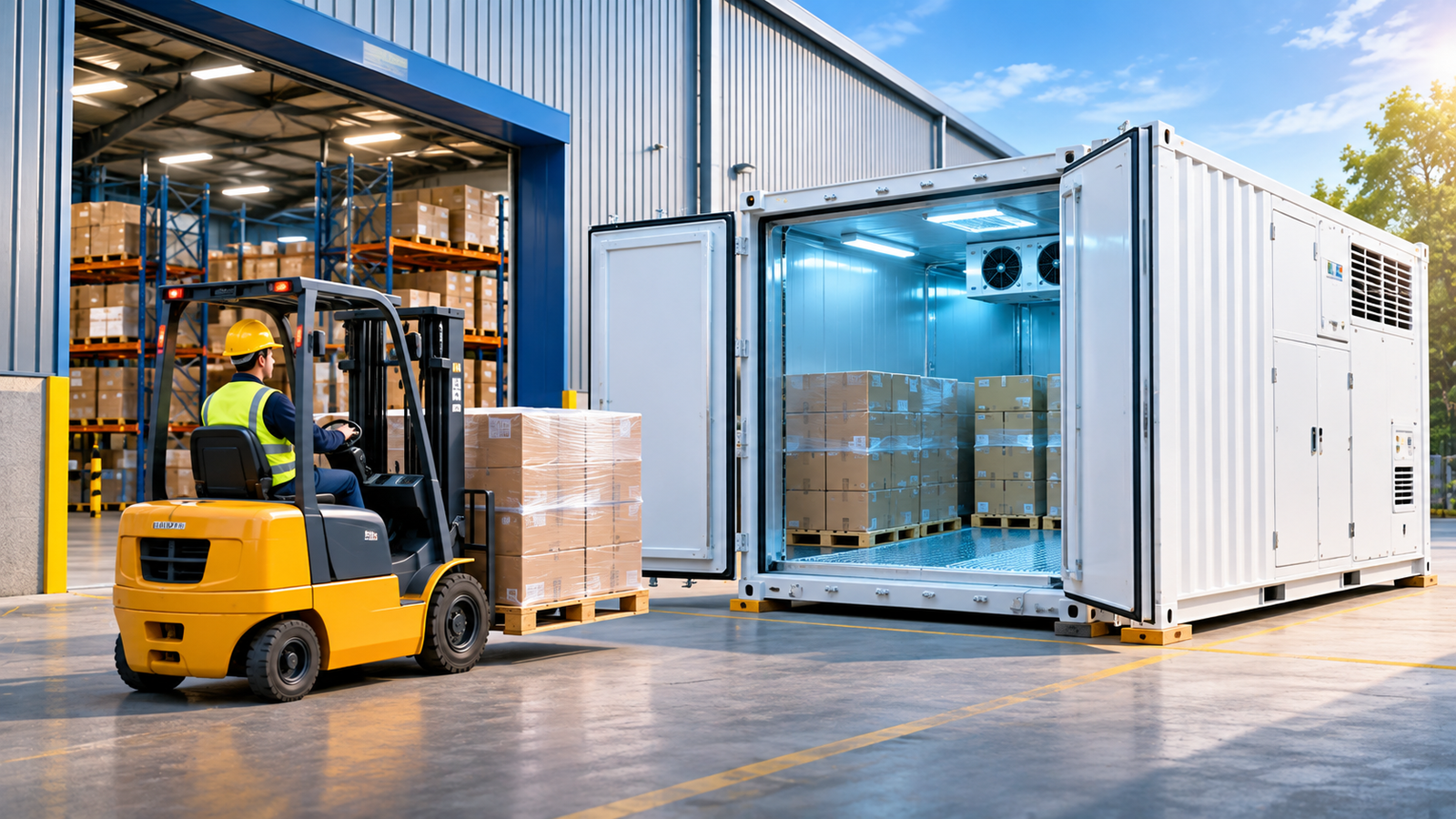
Running out of warehouse space can create problems long before a business reaches full capacity. Stock begins occupying operational areas, deliveries become harder to manage, and temperature-sensitive products may be stored in conditions that are not suitable for them.
For businesses handling valuable or environmentally sensitive inventory, simply adding more conventional warehouse space may not solve the problem.
Commercial climate controlled storage offers an alternative by providing additional capacity while maintaining the temperature and, where required, humidity conditions needed to protect stored goods.
A purpose-built climate controlled storage unit can help warehouses accommodate seasonal demand, manage unexpected stock increases, support expansion projects and protect sensitive inventory without immediately investing in permanent building alterations.
In this guide, we explore when additional climate controlled storage makes commercial sense, the factors warehouse managers should consider and how specialist storage containers can support growing operations.
Why Commercial Warehouses Need Additional Climate Controlled Storage
Warehouse capacity is not simply about how many pallets can fit inside a building.
Businesses must also consider stock characteristics, access requirements, environmental conditions and the operational space needed for safe and efficient handling.
A warehouse may have sufficient total floor space but lack suitable areas for products requiring controlled temperatures or humidity.
This creates several common challenges:
- Limited space for temperature-sensitive inventory.
- Seasonal increases in stock levels.
- Insufficient chilled, heated or humidity-controlled capacity.
- Temporary storage requirements during warehouse refurbishment.
- Changing customer contracts or product ranges.
- Increased risk of stock deterioration in unsuitable conditions.
- Delays caused by overcrowded storage and handling areas.
For these situations, an additional commercial climate controlled storage unit may provide a more practical solution than expanding the main warehouse.
1. When Existing Warehouse Capacity Is No Longer Suitable
One of the clearest signs that additional storage is needed is when a warehouse can no longer accommodate incoming stock without disrupting normal operations.
This may happen during periods of business growth, seasonal demand or changes in supplier delivery schedules.
However, the issue becomes more complicated when inventory requires specific environmental conditions.
For example, a warehouse handling electronic components may have plenty of general storage space but insufficient humidity-controlled capacity.
Similarly, a food manufacturer may need additional chilled storage during production peaks without requiring a permanent increase in refrigerated warehouse space.
In these circumstances, climate controlled storage containers can provide dedicated capacity for particular product categories.
This allows businesses to separate sensitive stock from general inventory while maintaining appropriate storage conditions.
2. Managing Seasonal Demand Without Permanent Warehouse Expansion
Many UK businesses experience significant changes in inventory levels throughout the year.
Food manufacturers, retailers, distributors and logistics providers may require additional storage during:
- Christmas and other peak trading periods.
- Seasonal food production.
- Promotional campaigns.
- Agricultural harvesting periods.
- Major customer contracts.
- Supply chain disruptions.
- Planned maintenance or refurbishment.
Building permanent storage capacity for a short period of increased demand may not be financially practical.
Temporary climate controlled storage provides an alternative.
Businesses can hire specialist storage containers for the period they need additional capacity, subject to availability and site suitability.
Once demand returns to normal, hired units can be removed rather than leaving the business with underused permanent infrastructure.
This flexibility is particularly valuable for warehouses where storage requirements change frequently.
3. Protecting Temperature-Sensitive and High-Value Inventory
Not all warehouse inventory can be stored safely under standard ambient conditions.
Some materials are sensitive to excessive heat, low temperatures, moisture or repeated environmental fluctuations.
Depending on the product and its manufacturer’s storage requirements, these conditions can affect quality, performance or shelf life.
Products that may require climate controlled storage
Electronic components and precision equipment
Excessive moisture and condensation can contribute to corrosion or damage to sensitive components.
Pharmaceutical and healthcare products
Certain products require defined temperature conditions, monitoring and documented storage procedures.
Food ingredients and finished products
Chilled, frozen or temperature-sensitive goods may require dedicated storage to maintain product quality and food safety.
Industrial chemicals, coatings and adhesives
Some products must be kept within specified temperature ranges to maintain stability and performance.
High-value artwork and specialist materials
Temperature and humidity fluctuations can affect sensitive materials, including certain artworks, documents and manufactured components.
The appropriate conditions vary considerably between products. A climate controlled storage unit should therefore be specified around the goods being stored, rather than assuming one standard temperature range is suitable for everything.
4. Climate Controlled Storage Units vs Expanding a Warehouse
When additional capacity becomes necessary, businesses typically consider several options.
These may include leasing more warehouse space, installing permanent environmental control systems, extending an existing building or introducing specialist storage containers.
Each approach has different financial and operational implications.
Permanent warehouse expansion
Extending a warehouse can be appropriate when additional capacity is expected to remain necessary for many years.
However, expansion may involve building works, planning considerations, substantial capital investment and disruption to existing operations.
Additional leased warehouse space
Leasing another facility can provide capacity without constructing a new building.
However, businesses may face additional transport, staffing, handling and inventory management costs if stock is held away from the main site.
Climate controlled storage containers
A climate controlled storage container can provide additional controlled capacity at or near an existing warehouse, where suitable space and infrastructure are available.
Potential advantages include:
- Additional storage without immediately extending the main building.
- Flexible hire or purchase arrangements.
- Dedicated environmental conditions for particular stock.
- The ability to position storage near existing operations.
- Modular capacity that can be adjusted as requirements change.
- Reduced need to transfer stock between separate warehouse locations.
The most appropriate solution depends on the required capacity, operating period, site constraints and total cost.
5. When a Climate Controlled Storage Unit Makes Financial Sense
Additional storage should be evaluated as a commercial investment rather than simply an extra operating expense.
The relevant question is whether the value of the additional capacity outweighs the cost of providing it.
Consider the cost of insufficient storage
A shortage of suitable warehouse space can create indirect costs, including:
- Delayed deliveries or production.
- Additional stock movements.
- External warehousing charges.
- Product deterioration or rejection.
- Increased handling time.
- Disruption to normal warehouse operations.
- Lost opportunities to accept additional customer orders.
Compare the full cost of available solutions
When evaluating commercial climate controlled storage, consider:
| Cost factor | What to assess |
|---|---|
| Initial investment | Purchase price or hire charges |
| Delivery and installation | Transport, positioning and site preparation |
| Electricity | Heating, cooling and humidity-control requirements |
| Maintenance | Servicing, inspections and repairs |
| Monitoring | Sensors, alarms and data recording |
| Storage duration | Short-term, seasonal or permanent requirements |
| Operational efficiency | Stock access, handling and proximity to existing facilities |
| Expansion flexibility | Whether capacity can be increased or reduced later |
For short-term or uncertain requirements, hiring may provide greater financial flexibility.
For predictable, long-term demand, purchasing a unit may offer better value over its operating life.
6. Choosing the Right Climate Controlled Storage Unit for a Warehouse
Before purchasing or hiring a climate controlled storage unit, warehouse operators should establish exactly what the additional space needs to achieve.
Temperature requirements
Identify the required operating temperature and acceptable variation.
Some products require refrigeration, while others need protection from cold conditions or excessive heat.
Humidity control
Temperature control and humidity control are not identical.
Where moisture levels could affect product quality, a specialist humidity-controlled container may be necessary.
Storage capacity
Consider the number of pallets, product dimensions, stacking requirements and available access space.
A larger unit is not always the most efficient option if the internal layout does not suit the warehouse’s handling processes.
Power supply
Confirm that the site has a suitable electrical supply for the chosen unit.
Power requirements depend on the container specification and environmental control equipment.
Loading and access
Consider how frequently staff will access the unit, whether forklift access is required and how the container will integrate with existing warehouse operations.
Monitoring and alarms
For sensitive inventory, temperature monitoring, humidity monitoring, data logging and alarm arrangements may be important.
The required monitoring specification should reflect the product’s risk profile and any applicable regulatory obligations.
7. Commercial Climate Controlled Storage for Different Warehouse Operations
Different industries require different storage conditions.
A specialist container solution can be configured around the needs of a particular operation.
Manufacturing warehouses
Manufacturers may require controlled storage for components, raw materials, coatings or finished products.
Additional capacity can also support production increases or temporary changes in manufacturing schedules.
Food and beverage distribution
Food businesses may need extra refrigerated or frozen capacity during seasonal peaks, warehouse maintenance or unexpected increases in stock.
Pharmaceutical and healthcare logistics
Some medicines, ingredients and healthcare products require monitored storage conditions.
Any proposed unit must be assessed against the relevant product specifications and regulatory requirements.
Third-party logistics providers
Logistics companies handling multiple customer contracts may need to introduce specialist storage capacity without permanently modifying their existing warehouse.
Electronics and precision engineering
Humidity-controlled environments can help manage moisture-related risks for suitable sensitive components and materials.
These applications demonstrate why industrial climate controlled storage should be selected according to operational requirements rather than treated as a standard storage product.
8. Climate Controlled Container Hire or Purchase: Which Is Better?
The decision to hire or purchase depends largely on how long additional capacity will be needed.
When hiring makes sense
Climate controlled container hire may be suitable when:
- Demand is seasonal or unpredictable.
- Additional capacity is needed during refurbishment.
- A temporary customer contract requires controlled storage.
- The business wants to test a storage arrangement before investing.
- Long-term requirements have not yet been established.
When purchasing makes sense
Buying a climate controlled storage unit may be more suitable when:
- Storage requirements are consistent throughout the year.
- The business expects to use the unit for an extended period.
- A permanent, dedicated storage area is needed.
- Bespoke specifications are required.
- The long-term cost of ownership is commercially attractive.
Businesses should compare the total cost of both options, including energy consumption, maintenance, delivery and any site modifications.
9. Why Businesses Choose ConRail for Additional Storage Capacity
ConRail supplies specialist storage containers for businesses requiring more than conventional dry storage.
With experience supporting organisations since 2009, ConRail offers a range of solutions for industrial, manufacturing, logistics and other commercial applications.
Its specialist container range includes:
- Refrigerated containers for chilled storage requirements.
- Heated containers for materials requiring controlled warmth.
- Humidity-controlled containers for products sensitive to moisture.
- Deep-freeze containers for specialist low-temperature applications.
- Bespoke container solutions for non-standard storage requirements.
Conrail provides both container hire and purchase options, allowing businesses to choose an arrangement that suits their operational needs.
For commercial warehouses, this can provide a way to introduce additional controlled storage capacity without immediately committing to a permanent building extension.
The ConRail team can help businesses identify suitable specifications based on storage conditions, capacity, operating period and site requirements.
Frequently Asked Questions
What is commercial climate controlled storage?
Commercial climate controlled storage refers to storage facilities or units designed to maintain specified environmental conditions for business inventory. Depending on the application, this may involve temperature control, humidity control or both.
Can climate controlled storage units be installed outside a warehouse?
Many specialist storage containers are designed for outdoor use. However, installation depends on ground conditions, electrical supply, access, ventilation, safety requirements and any applicable permissions.
Is climate controlled storage suitable for temporary warehouse overflow?
Yes. Where the correct unit and site infrastructure are available, climate controlled containers can provide additional capacity during seasonal peaks, refurbishment or unexpected inventory increases.
What is the difference between climate controlled storage and refrigerated storage?
Refrigerated storage primarily maintains a defined temperature range. Climate controlled storage may additionally regulate humidity, depending on the unit’s design and specification.
Can businesses hire climate controlled storage units in the UK?
Yes. ConRail offers specialist container hire as well as purchase options for commercial and industrial requirements.
Are climate controlled storage units suitable for long-term use?
They can be suitable for long-term applications when correctly specified, installed and maintained. The decision should account for energy use, servicing, capacity and total operating cost.
How much does a commercial climate controlled storage unit cost?
Costs depend on the unit size, environmental control requirements, specification, hire duration or purchase arrangement, delivery location and installation requirements. A tailored quotation is usually needed.
What information should I provide when requesting a quote?
It helps to provide the products being stored, required temperature and humidity conditions, estimated storage volume, site location, available power supply and expected duration of use.
Conclusion: Expand Warehouse Capacity Without Compromising Storage Conditions
Warehouse expansion does not always require a larger building.
When additional capacity is needed for temperature-sensitive or humidity-sensitive inventory, commercial climate controlled storage can provide a practical alternative to permanent construction or off-site warehousing.
The right climate controlled storage unit can help businesses manage seasonal demand, protect valuable stock, support warehouse refurbishment and respond to changing operational requirements.
For companies evaluating climate controlled storage containers in the UK, the key is selecting a solution that matches the products, site conditions and expected duration of use.
Need additional climate controlled storage capacity for your warehouse?
ConRail supplies specialist storage containers for hire and purchase, including refrigerated, heated, humidity-controlled and bespoke solutions.
Contact ConRail today to discuss your warehouse storage requirements and request a tailored quotation.