
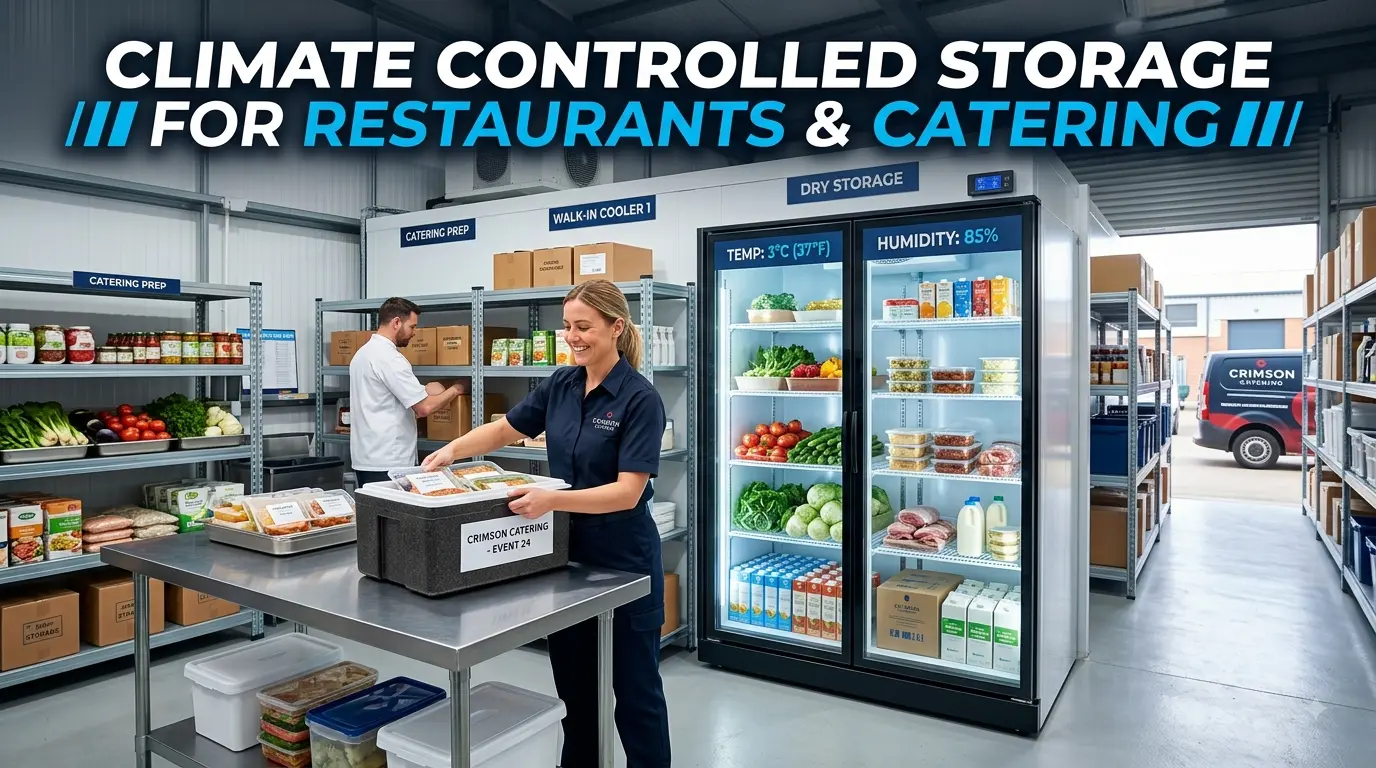
Your walk-in is full, a delivery just landed on the loading bay with nowhere to go, and you’ve got a 200-cover wedding to cater in ten days. Or maybe your cold room compressor has just failed on a Friday afternoon, or you’re mid-refurbishment, and the kitchen has no working refrigeration at all.
None of these situations means your restaurant or catering business needs bigger premises. They usually mean you need more temperature-controlled capacity, for a limited period of time – which is a very different problem to solve.
For food businesses, the umbrella term “climate-controlled storage” usually breaks down into something more specific: chilled storage Container, refrigerated storage Container, frozen storage Container, or temperature-controlled storage more broadly, depending on what’s actually being stored and at what temperature. This article looks at when restaurants and catering companies genuinely need extra capacity, what to consider before hiring it, and where a refrigerated container fits in as a practical, temporary option.
Do restaurants and catering companies need climate-controlled storage?
Often, yes – most food businesses handle at least some ingredients or prepared food that must be kept within a specific temperature range to stay safe and usable. The question isn’t really whether controlled storage matters (it clearly does for chilled and frozen goods), but whether your existing capacity is enough for what your business is actually doing right now.
It helps to be clear on the different categories:
- Dry storage Container– ambient conditions, for non-perishable stock like tins, dry goods and packaging.
- Chilled storage Container – for perishables that need to stay cold but not frozen.
- Refrigerated storage Container – a broader term covering both chilled and frozen storage, typically using mechanical refrigeration.
- Frozen storage Container – for goods that need to be kept well below 0°C.
Most restaurants already have some combination of these built into their kitchen. The issue tends to arise when demand, an equipment failure, or a building project temporarily pushes requirements beyond what’s already in place.
When does a restaurant need extra refrigerated storage?
- Your existing refrigeration is full. A large delivery, a promotional push, or simply a busy period can leave you with more chilled or frozen stock than your walk-in or under-counter units can hold.
- You’re preparing for a large event. A wedding, festival booking, conference contract or big private function often means bringing in far more perishable stock than a normal week – sometimes days in advance.
- Seasonal demand increases. Christmas trading, summer events and other predictable peaks routinely push storage needs well above the rest of the year.
- A refrigeration system fails. A broken compressor or a cold room that’s gone down overnight leaves you needing somewhere safe to move stock while it’s fixed – ideally before anything is at risk of spoiling.
- A kitchen is being refurbished. Losing access to your normal walk-in or cold room during building work doesn’t have to mean stopping service altogether, provided there’s a temporary alternative in place.
- Your catering business is growing. Extra capacity can bridge the gap while you work out whether the growth is sustained enough to justify permanent expansion.
- You receive unusually large deliveries. Bulk-buying, supplier promotions or a change in your supply chain can land you with more stock than expected at short notice.
What foods might require refrigerated storage?
The specific temperature a product needs depends on the item and the applicable food-safety requirements, but common examples of food that typically require chilled or frozen conditions include:
- Meat and poultry
- Fish and seafood
- Dairy products
- Prepared and ready-to-eat foods
- Sauces and dressings
- Desserts
- Certain fresh produce
Under UK food hygiene regulations, high-risk chilled food must legally be kept at 8°C or below in England, Wales and Northern Ireland, with the Food Standards Agency recommending 5°C or below as best practice. Frozen food is generally expected to be held at -18°C or below. Requirements vary by product and by nation (Scotland’s rules differ slightly), so always check current FSA guidance or your local authority’s environmental health team for anything specific to your business.
Can a refrigerated container be used as temporary cold storage?
Yes, in many cases. A suitably specified refrigerated container – often called a reefer – can provide additional chilled or frozen capacity on-site without the time, cost or disruption of extending a building. Because these units are mobile, they can be delivered where they’re needed, used for as long as the requirement lasts, and removed once it’s over.
The main advantages for a restaurant or catering business are:
- Additional capacity without a building project
- Temporary deployment – hire for a season, an event, or an emergency
- Flexibility to scale up or down as your needs change
- A practical stopgap during refurbishment or equipment failure
- On-site positioning at your restaurant, kitchen, or event location
It’s worth being realistic here too: not every refrigerated container is automatically suitable for every type of food or every site. The right unit depends on the temperature range you need, the volume of stock, and practical factors like power supply and access – which is exactly the kind of thing worth discussing with a supplier before booking anything.
Refrigerated container vs building a permanent cold room
Neither option is universally “better” – it depends on how long you actually need the extra capacity for.
A temporary refrigerated container tends to suit:
- Short-term capacity needs
- Seasonal demand spikes
- One-off events
- Refurbishment periods
- Emergency cover after an equipment failure
- Testing whether additional capacity is genuinely needed before committing further
A permanent cold room tends to suit:
- Long-term, predictable demand
- Businesses with the space and budget for a capital investment
- Operations where the extra capacity will be needed indefinitely, not just occasionally
If you’re not sure which category your business falls into, that uncertainty is itself a useful signal – it often points towards hiring temporarily first, rather than committing to construction for a need that might not be permanent.
How much additional cold storage does a restaurant need?
Rather than guessing, it helps to work through a few practical questions:
- What’s your current storage capacity, and how much of it is typically full?
- What volume of stock do you expect at peak demand, not just on an average week?
- How often do deliveries arrive, and how much do they add at once?
- How many events, bookings, or seasonal peaks are you planning for?
- How long will the additional requirement actually last?
- What type of product needs storing – chilled, frozen, or a mix?
- What space do you have on-site, and how would a delivery access it?
The most common mistake is sizing additional storage around an average week rather than the peak requirement – the point at which you’re most likely to run out of space.
Temporary cold storage for catering companies
Catering businesses are a particularly strong fit for temporary refrigerated storage, because their storage needs are often naturally short-term and spike dramatically around specific jobs. Weddings, festivals, conferences, corporate events, large private functions and seasonal work can all mean handling several days’ worth of chilled stock in a single event, then dropping back to normal levels immediately afterwards.
Outdoor catering and temporary event kitchens add another layer to this – there may be no fixed refrigeration on-site at all, making a self-contained refrigerated unit the only realistic way to keep food within safe temperature ranges for the duration of the event.
Temporary refrigerated storage during restaurant refurbishment
A refurbishment often means losing access to your normal walk-in, cold room or main kitchen refrigeration for days or weeks at a time. Rather than pausing service completely, some businesses use additional refrigerated storage on-site as a temporary alternative – provided it’s suitable for the products involved and fits within the business’s own food-safety procedures.
This is very much a practical, case-by-case decision, and it’s worth planning it in alongside the rest of the refurbishment timeline rather than as an afterthought once the kitchen is already out of action.
What should you check before hiring refrigerated storage?
- Required temperature range
- Type of product being stored
- Storage capacity needed
- Duration of hire
- Site access for delivery
- Electrical requirements (refrigerated containers typically need a suitable power supply)
- Delivery and collection logistics
- Where the unit will be positioned on-site
- Loading and unloading arrangements
- Temperature monitoring requirements
- How it fits your food-safety procedures
- Cleaning requirements
- Security
- Backup or emergency arrangements if power is lost
How much does temporary refrigerated storage cost?
Cost depends on several factors, including container size, rental duration, delivery and collection distance, site location, any additional equipment needed, and availability at the time of booking. Rather than relying on a generic figure, it’s best to request a current quotation from Conrail based on your specific requirements.
Is temporary refrigerated storage cheaper than expanding a restaurant?
For a short-term or uncertain requirement, hiring additional refrigerated capacity generally avoids the capital cost and disruption of a permanent extension or new cold room – you pay for the period you actually need it, rather than committing to a building project for a need that might not last.
For a genuinely long-term, ongoing requirement, permanent infrastructure can make more financial sense over time, since hire costs accumulate the longer a unit is retained. The right call comes down to how confident you are that the extra capacity is a temporary spike rather than a new permanent baseline – and hiring first can be a low-risk way to find that out before committing to construction.
How restaurants can prepare for peak cold-storage demand
- Forecast seasonal demand ahead of time rather than reacting to it
- Review last year’s stock levels around the same period
- Speak to suppliers early about delivery volumes and timing
- Calculate your actual peak requirement, not an average
- Identify a temporary capacity option before demand arrives, not after
- Check site access in advance – especially for events or unfamiliar locations
- Put contingency arrangements in place for equipment failure
- Avoid leaving additional storage arrangements until the last minute, particularly around Christmas and other high-demand periods when availability can tighten
Is climate-controlled storage suitable for every restaurant?
Not in a one-size-fits-all sense. Requirements vary depending on what’s being stored – some businesses need ambient dry storage, others need chilled conditions, frozen conditions, or a combination of several. The right solution depends entirely on the products involved and the conditions they need to be kept in. Which is why it’s worth discussing your specific setup with a supplier rather than assuming a standard unit will automatically fit.
Why temporary refrigerated storage can make sense for catering businesses
Pulling the strongest use cases together, temporary refrigerated storage tends to make the most sense for:
- Seasonal peaks in demand
- Major events and large bookings
- Short-term overflow when existing capacity is full
- Kitchen refurbishment periods
- Refrigeration failure and emergency cover
- Business growth, before committing to permanent expansion
- Unusually large or unexpected deliveries
- Short-term projects with a clear end date
The common thread across all of these is flexibility. Capacity that scales up when you need it and disappears again when you don’t.
Temporary Refrigerated Storage from Conrail
Conrail supplies refrigerated containers for hire and sale across the UK, with units ranging from 10ft up to 40ft to suit different capacity needs. Manufacturers build these containers to ISO shipping standards. They can maintain precise temperatures across a wide range. From deep-frozen to chilled conditions and feature digital monitoring so you can verify settings on-site.
Conrail’s team can talk through your required temperature range, capacity, site access and power supply, and advise on delivery timescales for your location. Whether you need cover for a single event, a season, a refurbishment, or an emergency after an equipment failure, units can be hired for the period you actually need rather than committing to a permanent installation.
Need extra refrigerated storage for your restaurant or catering business? Speak to Conrail about your temporary storage requirements.
FAQs
What is climate-controlled storage for restaurants?
It’s storage kept within a specific temperature range – chilled, frozen, or otherwise controlled – suited to the food or ingredients being stored, rather than storage at whatever temperature the surrounding environment happens to be.
Do restaurants need temperature-controlled storage?
Most restaurants already rely on some form of it. Since chilled and frozen ingredients need to stay within safe temperature ranges. The question that usually matters day-to-day is whether existing capacity is enough for current demand.
What is the difference between chilled and climate-controlled storage?
Chilled storage refers specifically to keeping food cold but not frozen (typically 8°C or below by law in England, Wales and Northern Ireland, with 5°C recommended as best practice). “Climate-controlled” is a broader term that can also cover frozen or ambient-controlled storage.
Can a refrigerated container be used for restaurant food storage?
Yes, provided the unit is suited to the temperature range and volume required. Refrigerated containers are used across the food and hospitality sector for exactly this purpose.
Can catering companies hire temporary refrigerated storage?
Yes. Temporary hire is a common solution for catering businesses handling short-term spikes in storage needs around specific events.
What can be stored in refrigerated containers?
Refrigerated containers are used for a wide range of chilled and frozen goods, including meat, fish, dairy, prepared food and other temperature-sensitive stock, depending on the unit’s specification.
When would a restaurant need temporary cold storage?
Common triggers include running out of existing capacity, large events, seasonal demand, refrigeration failure, kitchen refurbishment, business growth, and unusually large deliveries.
Can refrigerated storage be used during a kitchen refurbishment?
Yes, it’s a common temporary solution while normal kitchen refrigeration is out of action – subject to the unit being appropriate for your products and food-safety procedures.
How much does temporary refrigerated storage cost?
This depends on container size, hire duration, location, and delivery requirements. Contact Conrail for a quote based on your specific needs.
How long can I hire refrigerated storage for?
Hire terms are generally flexible, from short-term event cover through to longer seasonal or project-based periods. Get in touch with Conrail to discuss timescales for your requirement.