
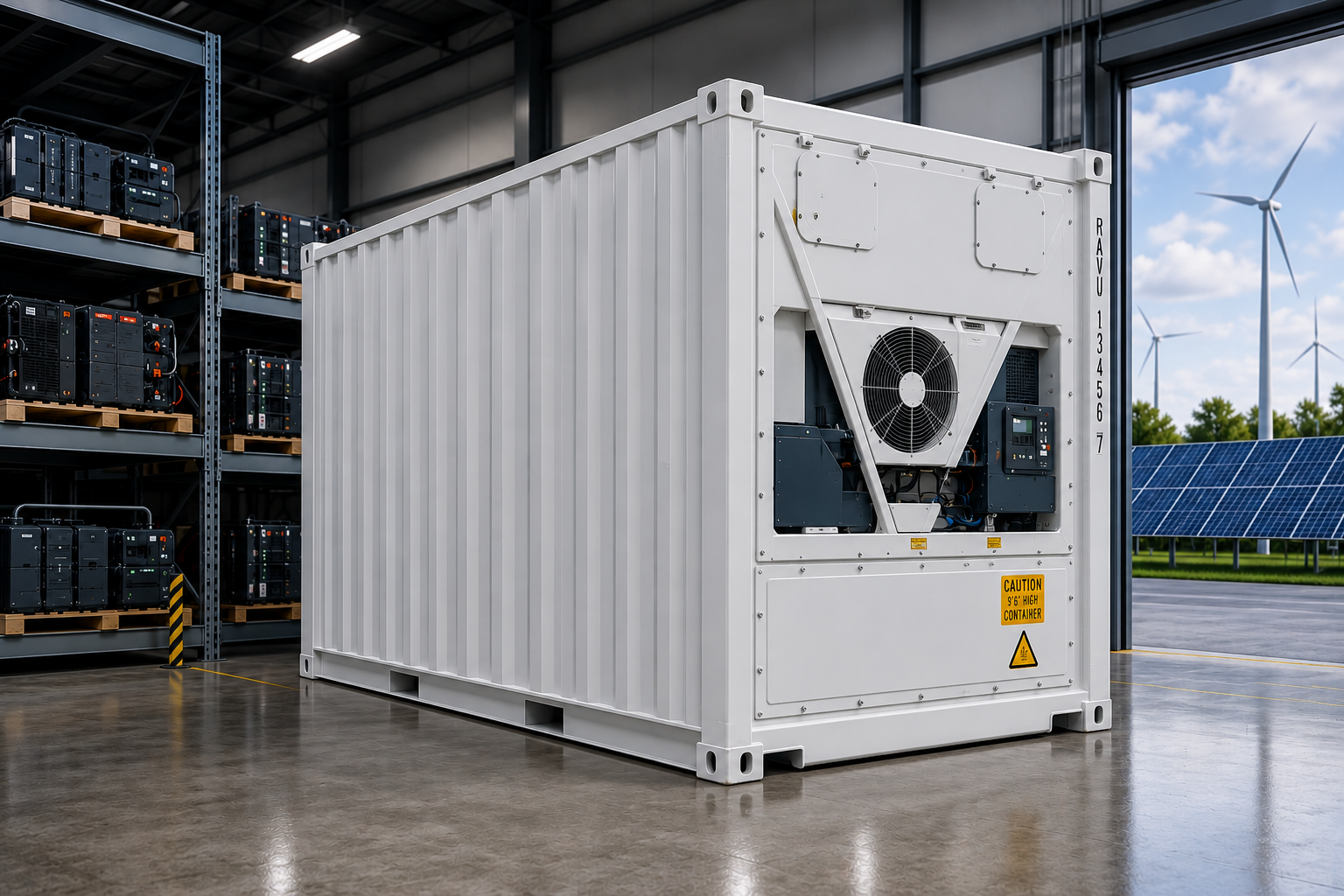
As the UK accelerates its shift toward electrification and renewable energy, commercial lithium-ion batteries have become mission-critical assets across warehousing, logistics, energy storage, and EV fleet operations. Whether you manage a forklift fleet, operate a battery energy storage system (BESS), or run a renewable energy site, one question is now at the top of every risk manager’s list:
“Are we storing our lithium batteries safely, compliantly, and cost-effectively?”
This guide draws on years of specialist experience supplying lithium battery storage containers across the UK. We cover the science, the regulations, the practicalities – and the costly mistakes businesses make when they get it wrong.
| ⚡ Quick Facts: Why Lithium Battery Storage Matters |
| A single thermal runaway event can release temperatures exceeding 700°C – standard sprinklers won’t stop it. |
| The UK government has committed over £2 billion to battery R&D and safety standards through to 2030. |
| New standard PAS 63100:2024 sets the bar for BESS fire safety in commercial settings. |
| Improper storage can void manufacturer warranties, invalidate insurance, and breach HSE regulations. |
| Conrail climate-controlled containers are deployed faster and at lower cost than permanent facilities. |
1. Why Commercial Lithium Battery Storage Is Different
Consumer lithium batteries – the ones in your phone or laptop – are relatively forgiving. Commercial and industrial lithium batteries are an entirely different proposition. A single battery pack for a forklift truck or grid-scale BESS unit can store hundreds of kilowatt-hours of energy. When that energy releases uncontrollably, the consequences are severe.
The Thermal Runaway Risk
Thermal runaway is the defining hazard of lithium battery storage. It occurs when an internal fault, mechanical damage, overcharging, or excessive heat causes an uncontrollable, self-sustaining exothermic reaction. Unlike conventional fires, thermal runaway:
- Generates its own oxygen – meaning it cannot be smothered
- Can spread from cell to cell within a battery pack
- Releases toxic gases including hydrogen fluoride
- Can re-ignite hours or even days after apparent extinguishment
- Requires specialist suppression systems – standard water sprinklers are insufficient
For businesses storing multiple units – whether forklift battery storage solutions, EV battery packs, or grid-connected BESS – the cumulative risk multiplies significantly. Proper lithium battery storage containers with built-in thermal management and fire suppression are not a luxury. They are a commercial and legal necessity.
2. UK Regulations and Compliance: What You Must Know
Regulatory compliance around industrial lithium battery storage in the UK has tightened considerably in recent years, driven by a significant increase in fires at logistics and recycling sites. Businesses must navigate:
| HSE Guidance | The Health and Safety Executive requires suitable risk assessments, appropriate storage conditions, and trained staff for all battery operations. |
| PAS 63100:2024 | The new Publicly Available Specification sets out fire safety requirements specifically for battery energy storage system (BESS) container storage. A key benchmark for insurers. |
| Building Regs | Any permanent battery storage facility may require planning permission and compliance with Part B (fire safety) of the Building Regulations. |
| Insurance | Insurers increasingly require documented evidence of compliant storage. Failure to demonstrate this can invalidate business interruption and property cover. |
| Manufacturer Warranty | Most battery manufacturers require specific temperature, humidity, and charge level conditions. Breach of these voids warranty. |
Conrail’s climate-controlled battery storage containers are designed with these regulatory requirements at their core, helping businesses demonstrate compliance from day one.
3. Best Practice: How to Store Commercial Lithium Batteries Safely
The following guidance applies to all commercial lithium battery storage solutions, including lithium iron phosphate (LFP), NMC, and sodium-ion chemistries. Always cross-reference with your battery manufacturer’s specific requirements.
3.1 Temperature Control – The Single Biggest Factor
Temperature is the most critical variable in commercial lithium battery storage. Exceeding optimal ranges accelerates chemical degradation and dramatically increases thermal runaway risk.
| Optimal range | 15°C to 25°C for most commercial lithium-ion chemistries |
| Above 30°C | Accelerates degradation; significantly increases risk of failure |
| Below 0°C | Can cause irreversible damage to battery chemistry |
| Consistent temp | Especially critical for large BESS units and containerised energy storage |
Conrail’s fully insulated, climate-controlled battery storage containers maintain stable temperatures year-round – critical given the UK’s variable climate. Both heating and active cooling are integrated, unlike basic insulated cabinets.
3.2 State of Charge (SoC) for Long-Term Storage
- Store at 30%–50% State of Charge for long-term storage
- Never store at 100% charge – this creates unnecessary stress on the cathode
- Never allow charge to drop below 20% for extended periods – risk of over-discharge damage
- Implement maintenance charging every 1-3 months (frequency depends on chemistry)
3.3 Environmental and Facility Requirements
- Humidity: Maintain 65%–75% relative humidity. Excess moisture accelerates corrosion; too dry and static risk increases.
- Non-combustible surfaces: Store on concrete or steel – never wood or plastic decking
- Separation distances: Maintain minimum separations from other batteries, flammable materials, and occupied buildings – check your insurer and HSE guidance for specifics
- Fire detection and suppression: Install systems rated for lithium fires. Standard smoke detectors and water sprinklers are inadequate for BESS container storage
- Racking: Use purpose-built racking rated for the weight of commercial battery packs – standard shelving is wholly unsuitable
3.4 Physical Protection and Handling
- Store in original packaging or approved crates where possible
- Protect terminals and busbars from accidental short circuit
- Keep batteries upright – avoid stacking unless racking is specifically rated for this
- Immediately quarantine any swollen, damaged, or faulty batteries in a dedicated secure area
- Use trained staff and appropriate PPE for all handling
3.5 Monitoring and Safety Systems
For commercial operations storing multiple units or high-capacity packs, passive storage is insufficient. Best-practice commercial battery storage solutions incorporate:
- Continuous temperature and voltage monitoring with remote alerting
- Off-gas detection (hydrogen fluoride, CO, and VOC sensors)
- CCTV with 24/7 monitoring
- Regular professional inspections and documented maintenance logs
- Clear emergency response procedures and staff training
4. Lithium Battery Storage Containers: Why a Specialist Solution Beats a DIY Approach
Many businesses attempt to repurpose existing storage space – a corner of a warehouse, a converted outbuilding, or a modified ISO container – for industrial lithium battery storage. This approach almost always falls short on at least one critical dimension: temperature control, fire suppression, ventilation, regulatory compliance, or structural rating.
A purpose-built lithium battery storage container from Conrail addresses all of these simultaneously:
| Climate control | Integrated heating and cooling maintains 15°C–25°C year-round regardless of external conditions |
| Fire suppression | Options for integrated suppression systems rated for lithium fires |
| Ventilation | Engineered ventilation prevents off-gas accumulation |
| Structural | Steel construction on non-combustible base; purpose-built racking rated for battery weights |
| Security | High-security locking; CCTV and alarm integration options |
| Compliance | Designed with PAS 63100:2024, HSE guidance, and insurer requirements in mind |
| Speed | Deployed in days – not the months required for a permanent facility build |
| Scalability | From a single container to a multi-unit site – modular and future-proof |
5. Industry Applications: Who Needs Specialist Battery Storage?
Demand for lithium battery storage UK-wide is being driven by several converging sectors:
Forklift Battery Storage Solutions
The UK’s warehousing and logistics sector is rapidly transitioning from lead-acid to lithium-ion forklift batteries. Lithium forklift batteries offer significant performance advantages – but they require fundamentally different storage. Unlike lead-acid, lithium forklift batteries must be stored at controlled temperatures and specific charge levels, and they cannot simply be left on a charge point indefinitely. For distribution centres and warehouses operating fleets of 10, 50, or 200+ trucks, a purpose-built forklift battery storage solution is essential.
EV Battery Storage Solutions
EV fleet operators – from delivery companies to local authorities – face a growing challenge: where to safely store spare or degraded EV battery packs. Whether managing a buffer of replacement batteries or decommissioning end-of-life packs ahead of recycling, secure battery storage containers with proper climate control are a legal and safety requirement. Our EV battery storage solutions are scalable from small urban depots to large multi-site fleet operations.
Battery Energy Storage System (BESS) Container Storage
Grid-connected and behind-the-meter BESS deployments are growing rapidly across renewable energy sites, industrial facilities, and commercial real estate. BESS container storage requires the highest standards of safety engineering – especially given the scale of energy involved. Our containers can be configured to support BESS installations from small commercial units to large-scale grid storage projects, fully compliant with PAS 63100:2024.
Renewable Energy Sites
Solar farms and wind projects increasingly use battery energy storage containers to store generated energy for despatch when needed. Safe, weatherproof, climate-controlled commercial energy storage containers are central to making these projects economically and operationally viable.
Industrial and Manufacturing
Manufacturers holding lithium battery stock for production processes, warranty replacements, or R&D require compliant industrial battery storage containers that protect both the product and the workforce. A documented storage policy supported by specialist infrastructure is increasingly a requirement of supply chain audits.
6. How Generative AI and Smart Technology Are Transforming Battery Storage Safety
The battery storage industry is at an inflection point. Generative AI and advanced data analytics are fundamentally changing how businesses monitor, manage, and future-proof their commercial lithium battery storage operations.
AI-Driven Predictive Monitoring
Traditional battery monitoring relies on threshold alerts – an alarm triggers when temperature or voltage exceeds a set point. AI-driven systems go further. By analysing continuous data streams from temperature sensors, voltage monitors, gas detectors, and strain gauges, machine learning models can identify subtle patterns that precede thermal events – often hours before any threshold is breached. This “state of safety” (SOS) modelling is becoming the gold standard for commercial battery storage solutions.
Generative AI for Maintenance and Compliance
Generative AI tools are now being deployed to help operations teams manage battery storage compliance documentation, generate maintenance schedules, and produce risk assessments. For businesses managing large battery fleets, AI can dramatically reduce the administrative burden while improving documentation quality – directly relevant to HSE audits and insurance reviews.
Digital Twins for BESS Optimisation
Digital twin technology – creating a virtual replica of a physical battery storage system – allows operators to simulate degradation, model failure scenarios, and optimise charge/discharge cycles without putting real assets at risk. For BESS container storage at scale, this is becoming a core tool for both safety and commercial performance management.
What This Means for Your Infrastructure
As AI-powered monitoring and management systems become standard, the physical container infrastructure they operate within must be capable of supporting them. Conrail’s climate-controlled lithium battery storage containers are designed with integration points for monitoring hardware, sensor networks, and building management systems – ensuring your storage solution remains compatible with next-generation technology.
7. The Future of Commercial Lithium Battery Storage: R&D Trends to Watch
The UK is investing heavily in battery technology and safety innovation. Understanding where the industry is heading helps businesses make storage infrastructure decisions that are future-proof.
- Next-generation solid-state electrolytes are inherently less prone to thermal runaway than liquid electrolyte cells. As solid-state batteries enter commercial production, storage requirements will evolve – but the need for temperature control and monitoring will remain.: Solid-state batteries
- LFP chemistry is gaining ground in commercial applications due to its superior thermal stability versus NMC. LFP-specific storage guidance (slightly different optimal SoC and temperature ranges) is becoming more widely established.: Lithium Iron Phosphate (LFP) growth
- Sodium-ion technology is entering the commercial market as a lower-cost, lower-risk alternative for some BESS applications. Conrail containers are adaptable to sodium-ion storage requirements.: Sodium-ion batteries
- Fire-retardant polymers and purpose-built suppression systems for lithium fires are being commercialised, offering significantly better containment than general-purpose systems.: Advanced fire suppression
- The UK government’s commitment of over £2 billion through the Faraday Institution, UK Battery Industrialisation Centre, and associated programmes is accelerating domestic innovation in safety, recycling, and supply chain – directly relevant to storage standards.: UK Battery Strategy
8. Commercial Lithium Battery Storage Checklist
| Use this checklist to audit your current storage arrangements |
| ✅ Storage temperature consistently maintained between 15°C and 25°C |
| ✅ Humidity controlled between 65% and 75% RH |
| ✅ Batteries stored at 30%–50% State of Charge for long-term storage |
| ✅ Maintenance charging schedule documented and followed (every 1–3 months) |
| ✅ Non-combustible flooring and surfaces (steel or concrete) |
| ✅ Minimum separation distances observed and documented |
| ✅ Fire detection and suppression system rated for lithium fires in place |
| ✅ Off-gas monitoring installed |
| ✅ Purpose-built racking rated for battery weights |
| ✅ All damaged, swollen, or faulty batteries quarantined immediately |
| ✅ Staff trained on lithium battery handling and emergency procedures |
| ✅ Written Lithium Battery Storage Policy in place |
| ✅ Regular professional inspections logged |
| ✅ Insurance policy reviewed and confirmed to cover lithium battery storage |
| ✅ Compliance with PAS 63100:2024 (for BESS applications) documented |
9. Why Businesses Across the UK Choose Conrail for Lithium Battery Storage Containers
At Conrail, we supply specialist climate-controlled storage containers designed specifically for commercial and industrial lithium battery storage. We are not a general container hire company that happens to offer battery storage – this is our specialism.
- Every container is designed around the specific requirements of commercial and industrial battery chemistries, not repurposed from general storage: Purpose-built for lithium battery storage
- Integrated heating and cooling maintains 15°C–25°C regardless of UK weather conditions – not just insulation: Fully climate-controlled
- Designed with HSE guidance, PAS 63100:2024, and insurer requirements in mind from the outset: Compliance-ready
- Racking, shelving, suppression systems, monitoring integration, and security options configured to your requirements: Customisable
- Operational in days – significantly faster and more cost-effective than constructing a permanent facility: Fast deployment
- Single container to multi-unit sites – our solutions grow with your operation: Scalable
- Our technical team provides genuine guidance, not just a sales conversation: Expert team
We serve warehouses, distribution centres, manufacturing facilities, renewable energy sites, EV fleet depots, and R&D facilities across the UK.
Frequently Asked Questions: Commercial Lithium Battery Storage UK
| Q: What is the ideal storage temperature for commercial lithium-ion batteries? |
| The optimal storage temperature for most commercial lithium-ion batteries is 15°C to 25°C. Temperatures above 30°C accelerate degradation and increase thermal runaway risk, while freezing temperatures can cause permanent damage to battery chemistry. Consistent temperature control is particularly important for large battery packs and BESS installations. |
| Q: What State of Charge should I store lithium batteries at? |
| For long-term storage, commercial lithium batteries should be maintained at 30%–50% State of Charge (SoC). Avoid storing at 100% charge, which stresses the cathode, and never allow batteries to drop below 20% SoC for extended periods. Implement a maintenance charging schedule every 1–3 months depending on chemistry. |
| Q: Do I need a specialist lithium battery storage container or can I use an existing building? |
| While an existing building may appear suitable, it almost always lacks one or more critical requirements: precise temperature control, engineered ventilation for off-gas, structural ratings for battery weights, and fire suppression systems rated for lithium fires. A purpose-built lithium battery storage container addresses all of these simultaneously and typically deploys far faster and at lower cost than a facility retrofit. |
| Q: What regulations apply to commercial lithium battery storage in the UK? |
| Key regulatory frameworks include HSE guidance on battery storage risk assessment, the new PAS 63100:2024 standard for BESS fire safety, Building Regulations Part B for permanent installations, and employer duties under the Health and Safety at Work Act 1974. Insurance requirements are increasingly specific – always check your policy wording covers lithium battery storage. |
| Q: What is BESS container storage and what are the specific requirements? |
| Battery Energy Storage System (BESS) container storage refers to the safe containment of grid-scale or commercial battery energy storage installations within purpose-built containers. BESS applications carry the highest energy densities and therefore the most stringent safety requirements, including compliance with PAS 63100:2024, specialist fire suppression, continuous monitoring, and minimum separation distances. Conrail provides BESS-rated container solutions. |
| Q: Can I store EV battery packs and forklift batteries in the same container? |
| This depends on chemistry, size, and charge state. While it may be technically possible, we generally recommend segregated storage for different battery types to simplify monitoring, maintenance scheduling, and emergency response procedures. Contact our team for site-specific guidance. |
| Q: How does AI help with commercial battery storage safety? |
| AI-driven monitoring systems analyse continuous data from temperature, voltage, and gas sensors to identify early warning signs of thermal events – often hours before conventional threshold alarms would trigger. Generative AI is also being used for compliance documentation, maintenance scheduling, and risk assessment generation. Conrail containers are designed to integrate with these monitoring technologies. |
| Q: How quickly can a Conrail battery storage container be deployed? |
| Our containers can typically be operational within days of order confirmation, significantly faster than constructing or converting a permanent facility. We handle delivery, positioning, and commissioning. Contact us for a site-specific timeline. |
| Q: What is the difference between a lithium battery storage unit and a climate-controlled container? |
| A basic lithium battery storage unit may offer insulation and security, but without active heating and cooling it cannot maintain the consistent 15°C–25°C range required for safe long-term storage of commercial batteries in the UK climate. Conrail’s climate-controlled battery storage containers incorporate both heating and active cooling to maintain optimal conditions year-round. |
| Get a Quote for Your Lithium Battery Storage Solution |
| Whether you need a single lithium battery storage container or a multi-unit site for BESS, forklift batteries, or EV fleet storage our team will specify and deliver the right solution. |
| Contact Conrail today: Visit conrail.co.uk | Speak to our technical team | Site surveys available UK-wide |
| Conrail.co.uk – Specialist Climate-Controlled Battery Storage Containers | UK-Wide |