
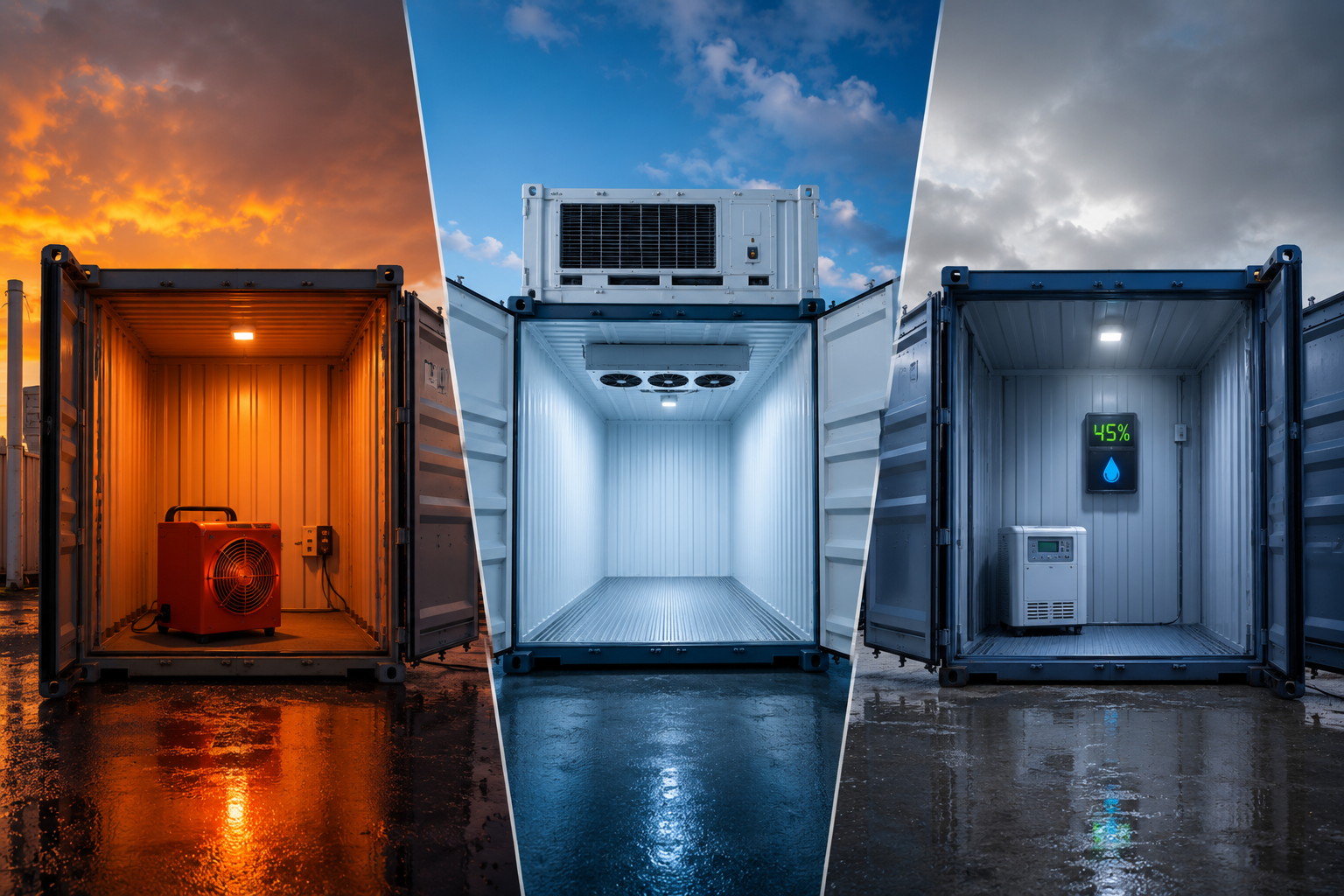
Ask most people what a “climate controlled container” does and they’ll assume it just keeps things cold. That assumption causes more wasted enquiries – and more wrongly specified containers – than almost anything else in this industry. Refrigerated, heated and humidity-controlled containers solve three genuinely different problems, and choosing the wrong one doesn’t just mean paying for features you don’t need. It can mean the difference between goods that survive a UK winter and stock that’s ruined by the time you notice.
This guide breaks down what each container type actually does, where the lines blur, and how to work out which one fits your application – whether that’s frozen food, classic cars, pharmaceuticals, or sensitive industrial materials.
The Quick Answer
| Container Type | Primary Job | Typical Range | Best For |
|---|---|---|---|
| Refrigerated (Reefer) | Cooling and freezing | -25°C to +30°C | Food, pharma, chemicals, anything that spoils in heat |
| Heated | Warming only | Up to +80/90°C | Frost protection, curing, drying, cold-climate storage |
| Humidity-Controlled | Precise temperature and moisture | -25°C to +30°C with adjustable humidity | Classic cars, archives, electronics, seed storage, R&D |
If your goods are damaged by heat or by frost, you probably need refrigeration or heating. If they’re damaged by dampness, condensation or dryness – regardless of temperature – you need humidity control. Many businesses need more than one, or specifically need the combined precision that only a humidity-controlled unit provides.
Refrigerated Containers: Solving the Heat Problem
Refrigerated containers, often called reefers, are built around one core job: bringing the temperature down and holding it there, consistently, regardless of what’s happening outside. A typical reefer can run anywhere from -25°C for frozen goods up to +30°C for a cool but not cold environment, which makes them flexible enough to cover deep-freeze storage, chilled food distribution, and simply keeping a space cooler than the ambient summer temperature.
The applications are broad. Food and drink businesses use reefers to protect perishables from farm to distribution. Pharmaceutical companies rely on them for vaccine storage and temperature-sensitive compounds where a few degrees of drift can mean a batch has to be discarded. Event organisers hire them for festival catering and seasonal stock overflow. Construction and remote sites use them simply because there’s no fixed cold storage infrastructure available on location.
What refrigerated containers don’t do, by default, is manage humidity independently of temperature. Cooling air naturally reduces its capacity to hold moisture, which is why reefers work well for food and pharma – but it’s not the same as the fine-grained humidity control that more sensitive goods require.
Heated Containers: Solving the Cold Problem
Heated containers exist for the opposite reason – protecting goods, equipment or vehicles from freezing rather than from heat. They can run up to +80°C or +90°C in some configurations, though most practical UK applications sit far lower than that, simply holding a space a few degrees above freezing through winter.
This makes heated containers the right call whenever the risk is frost damage rather than spoilage from warmth. Classic car storage in colder UK regions is a common use case – vehicles left in an unheated container over winter are vulnerable to condensation forming as temperatures swing, which leads to corrosion. Certain industrial processes also specifically require elevated temperatures – accelerated curing, drying processes, or storing materials that need to stay above a minimum threshold rather than below one.
It’s worth being precise here: a heated container solves the cold problem. It doesn’t automatically solve a humidity problem. You can have a heated space that’s still damp, particularly if warm air meets a cold container skin and condenses – which is exactly why some applications that sound like they only need heating actually need humidity control as well.
Humidity-Controlled Containers: Solving Both Problems at Once
This is where things get more specialised, and where a lot of buyers underestimate what they actually need. Humidity-controlled containers manage temperature and moisture together, typically across a -25°C to +30°C range with accuracy to within around 0.5°C, alongside adjustable humidity control.
The reason this matters: temperature and humidity don’t move independently in the real world. A container that’s simply “cold” or simply “warm” can still experience damaging humidity swings as the seasons change – and for certain goods, humidity is the more dangerous variable, not temperature.
Classic and prestige car storage is a good example. A collector doesn’t just want their car kept above freezing – they want to prevent the condensation cycle that corrodes chrome, perishes seals and encourages mould in upholstery, which happens because of humidity swings as much as temperature ones. Archives, documents and photographic materials degrade from humidity fluctuation regardless of whether the temperature itself is stable. Electronics are vulnerable to condensation forming on components even in a “cool” environment if moisture isn’t controlled. Seed storage, frozen DNA samples and R&D applications often specify both a precise temperature and a precise humidity band as a condition of the work itself, not as a nice-to-have.
If your goods are valuable, irreplaceable, or subject to a compliance requirement that specifies both temperature and humidity tolerances, a humidity-controlled container is very likely the correct specification – even if the initial ask sounds like “just keep it cool” or “just keep it above freezing.”
Working Out Which One You Need
A few practical questions help narrow this down before you request a quote:
- What actually damages your goods? Heat and spoilage point to refrigeration. Frost and freezing point to heating. Mould, corrosion, warping or condensation – even in a temperature-stable environment – point to humidity control.
- Is there a compliance or industry standard involved? Pharmaceutical, laboratory and certain food applications often specify exact tolerances for both temperature and humidity, which narrows the decision for you.
- What’s the value or irreplaceability of what’s being stored? Bulk seasonal stock can often tolerate a simpler refrigerated or heated solution. Classic cars, archives, and R&D materials usually justify the additional precision of humidity control.
- How long is the storage period? Short-term seasonal storage may only need temperature management. Long-term or permanent storage gives humidity swings more time to cause cumulative damage, which strengthens the case for humidity control.
- What does the UK climate do to your specific goods across a full year, not just in summer or winter? This is the question most people skip. A container spec that works fine in July can fail completely in a damp, cold February – and vice versa.
Where Businesses Get This Wrong
The most common mistake is specifying purely on temperature and assuming humidity will take care of itself. It won’t. Cooling air does reduce its moisture-holding capacity, but that’s a side effect, not a controlled outcome – which is precisely why goods stored in ordinary reefers can still develop condensation-related problems over time, particularly at the point where a chilled interior meets a warmer, damper exterior.
The second common mistake is over-specifying – paying for full humidity control on goods that genuinely only need protection from heat or frost. Bulk frozen food doesn’t need the same precision as a frozen DNA sample. Getting this right in both directions – not under-specifying sensitive goods, and not over-specifying straightforward ones – is exactly the kind of decision a proper site survey and consultation is meant to catch before a container is delivered rather than after something’s gone wrong.
Conclusion
Refrigerated, heated and humidity-controlled containers aren’t interchangeable products with different price tags – they solve genuinely different problems. Refrigeration protects against heat and spoilage. Heating protects against frost and freezing. Humidity control protects against the moisture swings that damage sensitive, valuable or irreplaceable goods regardless of temperature alone.
Getting the specification right from the outset saves far more than it costs. The wrong container doesn’t just underperform – it can mean returning damaged stock, corroded vehicles, or non-compliant storage conditions, all of which are considerably more expensive to fix after the fact than to specify correctly at the start.
If you’re not sure which category your storage need falls into, that’s exactly the conversation worth having before you commit to a container. Conrail’s team can talk through your specific goods, storage duration and risk factors, and recommend the right specification – refrigerated, heated, humidity-controlled, or a bespoke combination – rather than starting from a standard product and hoping it fits.
Frequently Asked Questions
Can a refrigerated container also control humidity?
Standard refrigerated containers manage temperature only; humidity changes as a side effect of cooling rather than as a controlled output. For applications where humidity itself needs to be precisely managed, a dedicated humidity-controlled container is the appropriate choice.
Do heated containers also prevent condensation?
Not automatically. Heating protects against frost and freezing temperatures, but condensation can still form where warm, moist air meets a cooler container surface. If condensation is a specific concern, humidity control is usually needed alongside heating.
Which container is best for classic car storage in the UK?
Humidity-controlled containers are generally the better fit for valuable or classic vehicles, since they protect against the condensation cycle that causes corrosion – a heated-only container prevents freezing but doesn’t fully address humidity-driven damage.
Is humidity-controlled storage more expensive than refrigerated or heated storage?
Typically yes, since it requires more precise environmental control systems. However, for goods where humidity damage is a genuine risk, the additional cost is usually far lower than the cost of replacing or writing off damaged stock.
Can one container switch between heating and cooling?
Some systems offer a wide adjustable range covering both cooling and heating within a single unit, particularly humidity-controlled models with ranges such as -25°C to +30°C. Whether this fits your needs depends on the specific application and tolerances required.
What industries typically need humidity-controlled containers rather than standard refrigeration?
Archives and document storage, classic car collections, electronics, seed and genetic material storage, and certain pharmaceutical or R&D applications commonly require humidity control specifically, rather than temperature control alone.
How do I know if my storage problem is a temperature issue or a humidity issue?
If damage occurs mainly during hot weather (spoilage, melting, degradation) it’s typically a temperature issue suited to refrigeration. If damage occurs regardless of temperature – mould, corrosion, warping, condensation – it’s typically a humidity issue requiring dedicated humidity control.