
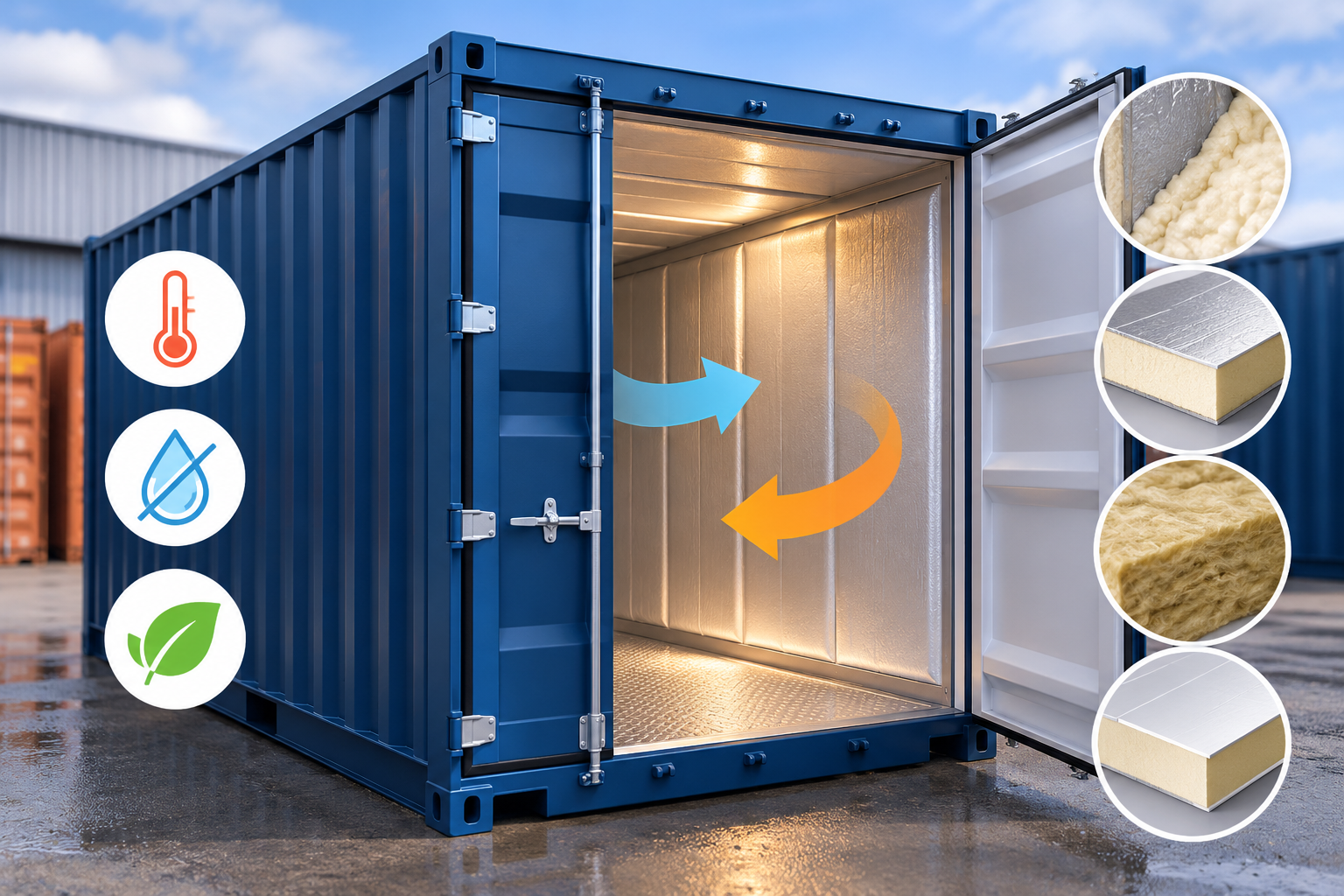
Shipping containers are widely used across manufacturing, logistics, construction and industrial storage. However, standard steel containers are not designed to maintain consistent internal temperatures. Without suitable insulation, stored materials can be exposed to excessive heat, cold and condensation, potentially affecting their quality, condition and usability.
Shipping container insulation helps reduce heat transfer between the inside and outside of a container, creating a more stable environment for temperature-sensitive goods. Depending on the application, insulation can also work alongside heating, refrigeration or humidity-control systems to maintain specific storage conditions.
For businesses considering insulated shipping containers, understanding the different insulation types, materials, costs and thermal performance is essential. This guide explains the available options, their benefits and how to select a suitable solution for commercial and industrial storage.
Why Is Shipping Container Insulation Important?
Standard shipping containers are constructed primarily from steel, which conducts heat efficiently. During summer, direct sunlight can cause internal temperatures to rise significantly. In winter, heat escapes through the walls, roof and floor, exposing stored goods to colder conditions.
These temperature fluctuations can be particularly problematic for chemicals, pharmaceuticals, manufacturing materials, electronic components and other sensitive products. Condensation can also develop when warm, moist air comes into contact with colder surfaces.
Properly designed shipping container thermal insulation reduces unwanted heat transfer and helps create more predictable storage conditions. It can also improve the efficiency of heating and cooling systems by reducing the amount of energy needed to maintain the required temperature.
The main benefits include:
- Temperature stability: Reduces rapid changes in internal temperature caused by external weather conditions.
- Product protection: Helps protect sensitive materials from excessive heat and cold.
- Energy efficiency: Reduces heating and cooling demands when combined with suitable temperature-control equipment.
- Condensation management: Can reduce the risk of surface condensation when supported by appropriate ventilation and moisture control.
- Operational flexibility: Makes containers suitable for a wider range of commercial and industrial storage applications.
Although insulation improves thermal performance, it does not actively regulate temperature. Applications requiring a specific temperature range may need additional heating or refrigeration equipment.
Shipping Container Insulation Types
Several shipping container insulation types are available, each offering different levels of thermal resistance, installation flexibility and suitability for industrial use. The right option depends on the container’s intended purpose, operating environment and temperature requirements.
1. Spray Foam Insulation
Spray polyurethane foam is applied directly to the container’s internal surfaces, expanding to form a continuous insulating layer. Its ability to follow the corrugated shape of steel walls makes it a common choice for container conversions.
Closed-cell spray foam can provide effective thermal resistance while reducing gaps through which air and moisture might otherwise pass. However, installation requires specialist equipment, appropriate surface preparation and consideration of fire safety requirements.
Spray foam can be suitable for certain storage conversions, particularly where an existing container needs insulation without extensive structural modifications.
2. PIR Insulation Boards
Polyisocyanurate (PIR) boards are rigid insulation panels that provide relatively high thermal resistance for their thickness. This makes them useful where internal storage capacity needs to be preserved.
PIR boards can be installed within a framed lining system across the container’s walls and ceiling. Their effectiveness depends on correct fitting, sealed joints and appropriate treatment of thermal bridges.
For businesses seeking practical shipping container insulation solutions, PIR boards can provide a balance between thermal performance and space efficiency.
3. Mineral Wool Insulation
Mineral wool is a fibrous insulation material commonly used where thermal, acoustic and fire-performance considerations are important. It is typically installed within a supporting framework and protected by an internal lining.
Certain mineral wool products offer high levels of fire resistance, making them relevant to applications where fire safety is a significant design consideration. However, the complete container assembly must still be assessed for compliance.
Moisture management is particularly important when using mineral wool, as the installation must prevent unwanted condensation within the wall structure.
4. Polystyrene Insulation
Expanded polystyrene (EPS) and extruded polystyrene (XPS) are lightweight rigid insulation materials used in various construction and storage applications.
These materials can provide thermal resistance at a relatively economical cost, although performance varies depending on the product, thickness and installation method.
Appropriate fire protection, internal lining and joint sealing are essential when incorporating polystyrene into an insulated container.
5. Insulated Sandwich Panels
Insulated sandwich panels combine a thermal insulation core with protective external facings. They are commonly used in engineered temperature-controlled environments, including cold storage and specialist industrial enclosures.
These panels can provide consistent construction, durable internal surfaces and effective thermal insulation when correctly specified and installed.
For demanding applications, purpose-built insulated storage containers using engineered panel systems may offer a more suitable solution than retrofitting a standard shipping container.
Comparing Shipping Container Insulation Materials
Different shipping container insulation materials offer different advantages. Selecting the right material involves balancing thermal efficiency, installation requirements, available space, moisture resistance and safety considerations.
| Insulation material | Main advantages | Important considerations |
|---|---|---|
| Spray foam | Conforms to corrugated surfaces and reduces installation gaps | Requires specialist application and appropriate fire protection |
| PIR boards | High thermal resistance relative to thickness | Joints and thermal bridges require careful detailing |
| Mineral wool | Thermal and acoustic insulation with suitable fire-performance options | Requires framing, lining and moisture management |
| EPS/XPS | Lightweight and potentially economical | Fire protection and material suitability must be assessed |
| Sandwich panels | Integrated insulation system with durable finishes | Performance depends on panel construction, joints and installation |
The best insulation for shipping containers is not necessarily the material with the lowest initial price. For commercial applications, long-term performance, durability and compatibility with the intended storage conditions are equally important.
How Does Shipping Container Thermal Insulation Work?
Shipping container thermal insulation works by slowing the transfer of heat through the container’s walls, roof and floor. Its effectiveness depends on the insulation material’s thermal conductivity, thickness and how the complete system is constructed.
Thermal conductivity describes how readily a material transfers heat. Materials with lower thermal conductivity generally provide better insulation at the same thickness. Thermal resistance, often expressed as an R-value, indicates how strongly a layer resists heat transfer.
However, insulation performance is not determined by material thickness alone. Steel framing, door seals, floor construction and service penetrations can create thermal bridges that allow heat to bypass insulated sections.
For industrial container insulation, the complete enclosure must therefore be considered. A container with well-insulated walls but poorly sealed doors may still experience substantial temperature fluctuations, particularly during frequent loading and unloading.
Effective shipping container insulation systems address these factors through suitable materials, continuous insulation, appropriate door construction and careful installation.
What Is the Best Insulation for Shipping Containers?
The best insulation depends on the type of goods being stored and the environmental conditions they require. A container used for general equipment storage may need a different specification from one designed for chemical processing or pharmaceutical materials.
For standard commercial storage, insulated walls and ceilings may provide sufficient protection against moderate temperature fluctuations. Where products must remain above a minimum temperature, insulation may need to be combined with heating equipment.
For materials requiring cooling, refrigeration or tightly controlled environmental conditions, a purpose-built temperature-controlled container is often more appropriate.
Businesses should consider the following when selecting an insulation solution:
- Required internal temperature range
- External operating temperatures and weather exposure
- Type, quantity and sensitivity of stored materials
- Container dimensions and available internal space
- Frequency of loading and unloading
- Moisture and humidity requirements
- Heating, cooling and electrical requirements
- Expected operating costs and maintenance needs
For specialist applications, consulting an experienced container supplier can help ensure the insulation and temperature-control systems are suitable for the intended use.
How to Insulate a Shipping Container
Businesses researching how to insulate a shipping container should understand that effective insulation requires more than fitting panels or applying foam to steel surfaces.
The first step is to assess the container’s condition and determine the required internal environment. Any existing corrosion, moisture problems or structural damage should be addressed before insulation work begins.
The next stage involves selecting suitable insulation materials and establishing the required thickness. Walls, ceilings and floors must be considered together to minimise thermal bridging and unwanted heat transfer.
Correct installation is particularly important around doors, corners, joints and service penetrations. These areas can significantly affect the performance of the completed system if they are not properly sealed.
Ventilation and vapour control also require attention, as poorly designed insulation can trap moisture and contribute to hidden condensation problems.
Finally, any heating, refrigeration or monitoring equipment should be selected according to the intended operating conditions. Where temperature control is critical, the completed installation should be tested against the required performance specification.
For industrial storage, professionally designed insulated or temperature-controlled containers may provide a more reliable alternative to modifying a standard container.
Shipping Container Insulation Cost: What Should Businesses Expect?
Shipping container insulation cost varies according to the container size, insulation materials, required thermal performance and installation complexity.
A basic conversion intended to moderate temperature fluctuations will have different requirements from an industrial container designed to maintain a controlled temperature throughout the year.
The main factors influencing cost include the insulation material and thickness, wall and ceiling finishes, floor insulation, door modifications, labour and any specialist temperature-control equipment.
Container size also affects the amount of material required, while bespoke configurations may involve additional design and installation work.
Businesses should consider long-term operating costs alongside the initial investment. Better thermal performance can reduce heating and cooling requirements, although actual savings depend on the equipment, operating conditions and frequency of access.
Is It Better to Insulate an Existing Container or Buy an Insulated Container?
Retrofitting an existing container can be practical for straightforward storage applications, particularly where precise temperature control is not essential.
However, a purpose-built insulated shipping container may be more suitable for businesses with demanding operational requirements. Specialist containers can incorporate integrated insulation, appropriate doors and temperature-control equipment designed to work together.
For temporary projects, insulated container hire can also provide an alternative to purchasing and converting a container.
The most suitable option depends on the required performance, project duration, budget and intended application.
Insulated Shipping Containers vs Temperature-Controlled Shipping Containers
Although the terms are sometimes used interchangeably, insulated and temperature-controlled containers serve different purposes.
An insulated shipping container reduces heat transfer between the internal and external environment. It can help moderate temperature fluctuations but does not actively maintain a specified temperature.
Temperature controlled shipping containers combine insulation with equipment such as heating or refrigeration systems to regulate internal conditions.
For example, insulation can slow heat loss during winter, but a heating system is required when stored materials must remain above a defined temperature for an extended period. Similarly, refrigeration is necessary when goods must be maintained below ambient temperatures.
This distinction is important for businesses handling sensitive materials, as the correct solution must meet the actual storage requirements rather than simply provide an insulated enclosure.
Heated Shipping Containers: When Insulation Alone Is Not Enough
Certain industrial materials require controlled warming to prevent freezing, maintain suitable viscosity or prepare products for processing. In these situations, heated shipping containers combine thermal insulation with dedicated heating systems to provide a more controlled storage environment.
At Conrail, we supply specialist heated storage containers for commercial and industrial applications. Our heated container range includes units lined with 120 mm insulation, with configurations capable of reaching approximately 80–90°C depending on the application.
Our heated containers can also incorporate specialist access arrangements, including sluice doors designed to help reduce heat loss during loading and unloading.
These solutions are suitable for selected applications involving plastics, foils, chemicals, pharmaceuticals and automotive-related materials, subject to the specific handling and safety requirements.
Heated Containers for Drum and IBC Pre-Heating
Some industrial materials require pre-heating before they can be handled or processed efficiently. This may involve warming drums or Intermediate Bulk Containers (IBCs) to achieve the required material consistency or processing temperature.
We offer heated containers for drum and IBC pre-heating, with suitable configurations supporting temperatures up to 80°C.
Our containers are available for hire or sale, with configurations and temperature settings selected according to customer requirements.
Businesses can explore our heated container range to learn more about the available options.
Industrial Container Insulation: Common Applications
Industrial container insulation is used across sectors where external temperature fluctuations can affect stored materials, product quality or operational efficiency.
Manufacturing and Engineering
Manufacturers may require insulated storage for raw materials, components and process-related supplies. Depending on the application, controlled heating can also help maintain suitable handling conditions for certain materials.
Chemical Storage and Processing
Some chemicals and industrial products require protection from low temperatures or controlled warming before processing. Insulated and heated containers can support these applications when appropriately specified for the materials and relevant safety requirements.
Pharmaceuticals
Pharmaceutical products and materials may require controlled environmental conditions. Depending on the products involved, suitable containers may need temperature monitoring, validation and additional compliance measures.
Food Production and Distribution
Food-related businesses may use insulated or refrigerated containers to support temperature-sensitive storage requirements. The appropriate solution depends on the product, required temperature range and applicable food safety standards.
Automotive and Industrial Materials
Certain automotive components, production materials and industrial supplies may benefit from insulated storage or controlled pre-heating before use.
In each case, the container’s insulation, heating or cooling equipment must be matched to the intended operating conditions.
Choosing Insulated Storage Containers for Hire or Sale
Selecting suitable insulated storage containers requires a clear understanding of the storage application. Businesses should establish the type and quantity of goods, required temperature range, available site space and expected duration of use before choosing a container.
It is also important to consider how frequently the container will be accessed, whether humidity control is necessary and what electrical supply is available.
For temporary or seasonal requirements, container hire may provide greater flexibility. Businesses with ongoing storage needs may prefer to purchase a suitable unit.
At Conrail, we supply a range of specialist containers for commercial and industrial applications. Our solutions include heated, refrigerated, deep-freeze, humidity-controlled and bespoke storage containers, with hire and purchase options available.
By understanding the intended use, we can help businesses identify suitable container configurations for their operational requirements.
Why Choose Conrail for Specialist Insulated Containers?
Since 2009, we have supplied specialist storage container solutions for businesses with demanding storage and temperature-control requirements.
Our container range includes heated shipping containers, refrigerated containers, deep-freeze units, humidity-controlled containers and bespoke modular systems.
We provide both hire and purchase options, helping businesses source suitable containers for temporary projects, seasonal demand and long-term industrial operations.
Rather than focusing solely on insulation materials, we consider the complete storage requirement, including container capacity, operating temperature, access arrangements and environmental controls.
For businesses looking for specialist shipping container insulation solutions, our range of insulated and temperature-controlled containers offers options for a variety of industrial applications.
Final Thoughts
Shipping container insulation plays an important role in protecting stored goods, reducing unwanted heat transfer and improving the suitability of containers for commercial and industrial use.
Different insulation materials offer different benefits, but overall performance depends on the complete system, including insulation thickness, door construction, thermal bridging and moisture management.
For general storage, an insulated container may provide sufficient protection. Where materials require specific operating temperatures, heated or refrigerated containers can offer a more appropriate solution.
Looking for insulated or heated shipping containers for your business?
At Conrail, we offer specialist containers for hire and sale, including solutions for temperature-sensitive industrial materials and demanding storage environments.
Explore our heated shipping containers or contact our team to discuss your storage requirements and request a quotation.
Frequently Asked Questions
What is the best insulation for a shipping container?
The best insulation depends on the intended use, temperature requirements and installation conditions. Spray foam, PIR boards, mineral wool and insulated sandwich panels are common options. For demanding industrial applications, a purpose-built insulated container may be more appropriate.
How much does shipping container insulation cost in the UK?
Shipping container insulation costs vary according to container size, insulation type, material thickness and installation requirements. Additional heating, cooling and monitoring equipment can increase the total cost. A project-specific quotation provides the most accurate estimate.
Can you insulate an existing shipping container?
Yes, existing shipping containers can be insulated using spray foam, rigid insulation boards or other suitable systems. However, the container’s condition, ventilation, moisture control and fire safety requirements must be assessed before installation.
Are insulated shipping containers suitable for winter storage?
Insulated containers can reduce heat loss and help moderate internal temperatures during winter. However, products requiring a guaranteed minimum storage temperature may need an actively heated container.
What is the difference between an insulated container and a heated container?
An insulated container reduces heat transfer, while a heated container combines insulation with heating equipment to maintain a required internal temperature within its operating capabilities.
Do insulated shipping containers prevent condensation?
Insulation can reduce condensation risk by limiting temperature differences across surfaces, but it does not eliminate condensation entirely. Ventilation, humidity levels, vapour control and installation quality also affect moisture management.
Can insulated shipping containers be hired?
Yes. We offer specialist container hire options for businesses requiring heated and temperature-controlled storage solutions, depending on the intended application and availability.
What insulation thickness is needed for a shipping container?
The required thickness depends on the insulation material, target internal temperature and external operating conditions. Our specialist heated container range includes configurations with 120 mm insulation, although requirements vary between applications.
Are insulated shipping containers energy efficient?
Properly specified insulation can reduce heat transfer and lower the demand on heating or cooling equipment. Actual energy performance depends on the complete container system, operating temperatures and usage patterns.
Can insulated shipping containers be used for industrial chemicals?
Yes, certain insulated and heated containers can be suitable for industrial chemical applications. However, compatibility with the stored materials, temperature requirements, ventilation and applicable safety regulations must be assessed.
Is it better to hire or buy an insulated shipping container?
Hiring may be suitable for temporary projects, seasonal requirements or short-term storage. Purchasing may be more economical for long-term operations requiring a consistent container configuration.
Does shipping container insulation reduce heating costs?
Effective insulation can reduce heat loss and the amount of energy required to maintain a heated container’s internal temperature. Actual cost savings depend on the insulation system, heating equipment, external conditions and operational use.