
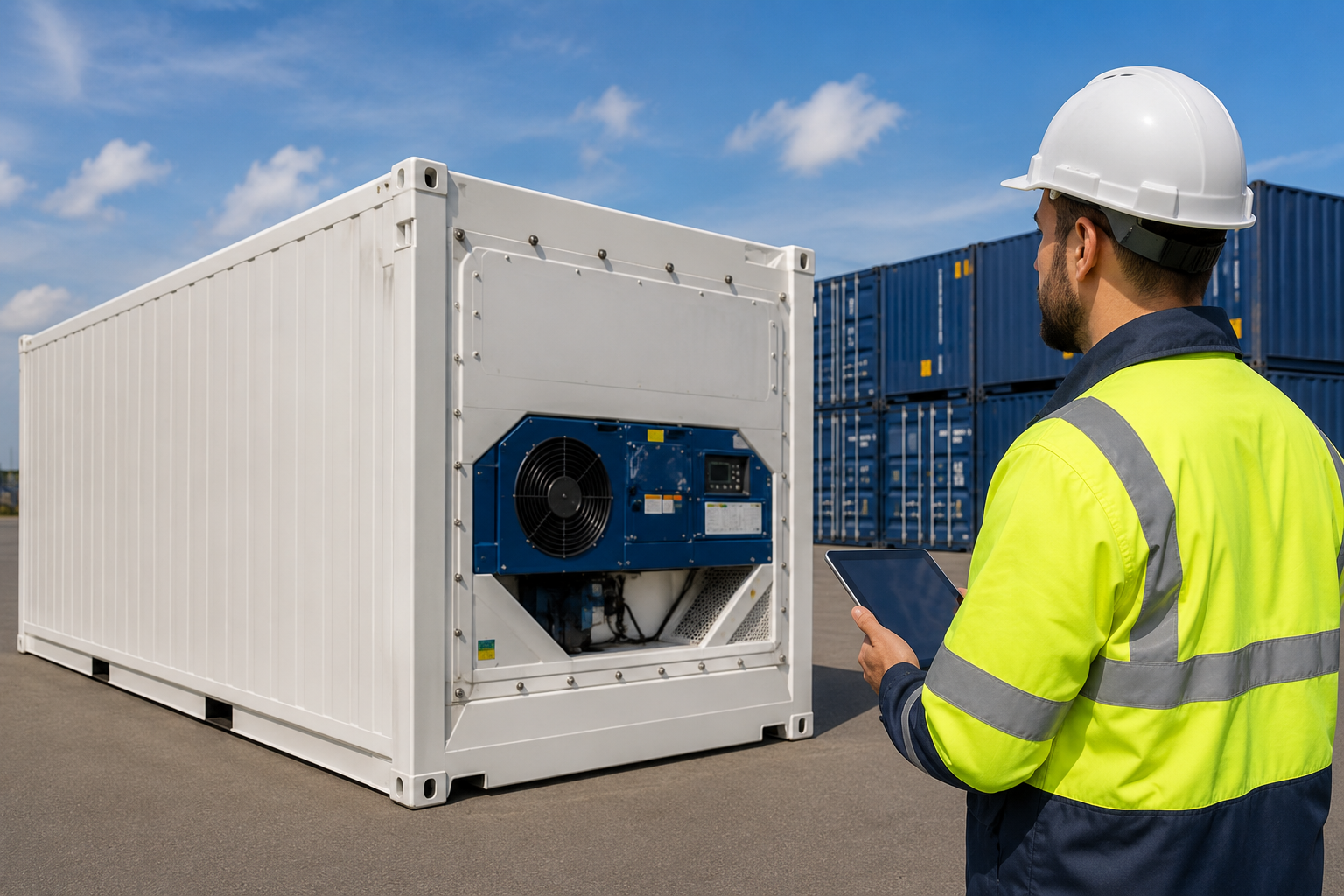
Whether you’re a food manufacturer dealing with a surge in seasonal demand, a pharmaceutical company that needs compliant cold chain storage, or a business simply exploring flexible alternatives to a fixed cold room, refrigerated container hire is worth understanding properly.
This guide pulls together the questions that businesses across the UK are genuinely asking – on Google, on AI tools like ChatGPT and Perplexity, and directly to suppliers like us at Conrail. We’ve answered each one as plainly as we can, without the sales gloss.
In this guide:
- What is a refrigerated container / reefer container?
- How does a reefer container actually work?
- Reefer container sizes in the UK – feet, metres and capacity
- What temperatures can a refrigerated container hold?
- How much does refrigerated container hire cost in the UK?
- Short-term vs long-term hire – which is better value?
- Cold storage container hire vs buying outright
- Cold room vs refrigerated container – honest comparison
- What power supply does a reefer container need?
- Can you use a refrigerated container indoors?
- Industries that commonly use reefer container hire
- Food grade, pharmaceutical and compliance requirements
- What to check when a container is delivered
- Is container leasing profitable as a business model?
- Frequently asked questions
What Exactly Is a Refrigerated Container – and What’s a Reefer?
The terms are used interchangeably, though there is a subtle difference in origin. A reefer container (short for refrigerated container) traditionally referred to the insulated, temperature-controlled units used in international shipping. In the UK hire market, people use both terms to describe the same thing: a standalone, self-contained cold storage unit that plugs into a power supply and maintains a set temperature range.
Unlike a refrigerated van, which is designed for transport, a hired reefer container is a static unit placed on-site – in a car park, loading bay, yard, or warehouse. It runs continuously for as long as you need it, whether that’s a few days or several years.
How Does a Reefer Container Work?
At its core, a refrigerated container works on the same refrigeration cycle as a domestic fridge or commercial cold room – just scaled up and contained within a robust steel shell. Here’s what’s actually happening inside:
- A compressor unit (typically mounted at one end of the container) circulates refrigerant gas
- The gas absorbs heat from inside the container and expels it outside
- A thermostat monitors the internal temperature and cycles the compressor on and off to hold the set point
- Insulated panels – usually polyurethane foam – in the walls, floor and ceiling reduce heat transfer from the outside
Modern reefer containers also include internal fans to circulate air evenly around the cargo, which helps prevent hotspots and ensures the temperature reading is representative of the whole unit – not just the air near the sensor.
The compressor unit runs on mains electricity (three-phase in most cases – more on this below) and can be monitored remotely on newer units, which is increasingly important for compliance-sensitive industries.
Reefer Container Sizes in the UK – Feet, Metres and Capacity
One of the most common searches we see is around sizing. People want to know the dimensions in both feet and metres, and what those sizes mean in practice. Here’s a straightforward breakdown:
| Size | Length (m) | Width (m) | Height (m) | Approx. Capacity |
| 10ft | 2.99m | 2.35m | 2.39m | ~14 cubic metres |
| 20ft | 5.90m | 2.35m | 2.39m | ~28 cubic metres |
| 40ft | 11.58m | 2.35m | 2.39m | ~60 cubic metres |
| 40ft HC | 11.58m | 2.35m | 2.70m | ~67 cubic metres (extra height) |
A few things worth noting on these figures:
- Internal dimensions are slightly smaller than the external measurements shown – typically by around 10–15cm per wall due to insulation thickness
- The 10ft unit is the most popular choice for small businesses, event caterers and sites with limited space = what many search for as a ‘small reefer container UK’
- The 40ft High Cube offers the same footprint as a standard 40ft but with an extra 30cm of internal height, which matters when stacking pallets
- Weight capacity varies by unit – always confirm maximum payload before loading
If you’re comparing reefer container sizes to standard dry shipping containers, the external dimensions are broadly the same – but reefer units have thicker walls and a smaller internal volume as a result.
What Temperature Range Can a Hired Reefer Container Reach?
This varies by unit specification and is one of the most important questions to ask before hiring. As a general guide:
- Standard reefer containers: typically +25°C down to -25°C
- Deep freeze or ultra-low temperature containers: can reach -40°C or lower
- Ambient-to-chill units: designed to hold between +2°C and +8°C, commonly used for chilled food and some pharmaceuticals
The distinction matters enormously in practice. A standard reefer hired from a general plant hire company may not achieve the deep freeze temperatures required for frozen food, biologics or certain pharmaceutical products. Always confirm the minimum achievable temperature = and ask for documentation of the unit’s calibrated performance, not just a spec sheet.
| Conrail note: Our climate containers are individually specified. If you need a particular temperature range — including deep freeze or ultra-low – tell us upfront and we’ll confirm whether the unit we’re quoting meets it before any paperwork is signed. |
How Much Does Refrigerated Container Hire Cost in the UK?
There’s no single answer to this, and any supplier quoting a definitive price without knowing your requirements should be treated with caution. Hire costs are influenced by several factors:
Factors that affect the price
- Container size – a 10ft unit costs less than a 40ft
- Temperature specification – standard chill is cheaper than deep freeze or ultra-low
- Hire duration – weekly, monthly or long-term rates differ significantly
- Delivery location and access – remote sites or restricted access can affect delivery costs
- Power supply requirements – if a generator or power upgrade is needed, this adds cost
- Additional features – temperature logging, remote monitoring, multiple door configurations
Rough market benchmarks (as a guide only)
Short-term weekly hire for a 20ft standard reefer container in the UK typically falls in the range of a few hundred pounds per week, with monthly rates offering better value for longer commitments. A 40ft deep freeze unit on a long-term contract will be priced considerably differently.
The most reliable approach is to request a written quote from a specialist supplier like conrail.co.uk – not a general plant hire firm – and make sure the quote itemises delivery, collection, power requirements and any maintenance provisions separately.
| Hidden costs to watch for: Fuel surcharges, power consumption where you supply a generator, cleaning charges at the end of hire, and call-out fees if something goes wrong outside business hours. A good supplier will spell these out upfront. |
Short-Term vs Long-Term Reefer Container Rental – Which Makes More Sense?
The right answer depends entirely on your situation. Here’s how to think about it:
Short-term hire (days to a few weeks) suits:
- Event catering – festivals, weddings, sporting events, outdoor markets
- Emergency overflow when a cold room breaks down or goes offline for maintenance
- Seasonal peaks – Christmas, summer produce, harvest periods
- Construction or site use where refrigerated storage is temporarily needed
Medium to long-term hire (months to years) suits:
- Businesses whose cold storage needs have outgrown their fixed infrastructure
- Food manufacturers, processors or distributors scaling operations
- Pharmaceutical or biotech companies needing compliant on-site storage
- Businesses testing demand in a new location before committing to a cold room build
One often overlooked advantage of long-term hire over buying: maintenance, servicing and breakdown cover typically remain the responsibility of the hire company. If the unit fails at 2am, that’s their problem to fix – not yours.
Refrigerated Container Hire vs Buying – Is It Better to Own or Rent?
Both routes have legitimate use cases. The honest comparison looks like this:
- Buying makes sense when: you have consistent, long-term need; you want to own the asset; you can handle maintenance in-house; and capital expenditure is preferable to ongoing revenue spend
- Hiring makes sense when: demand fluctuates; you need flexibility to scale up or down; you want maintenance included; or you’re not yet sure exactly what specification you need long-term
One question that comes up often: is container leasing profitable as a business model? For operators who buy containers and lease them to clients, margins can be reasonable – but it depends heavily on utilisation rates, maintenance costs and the depth of the customer base. For most end users, that question is less relevant than understanding whether hire vs ownership gives them the better operational outcome.
Cold Room vs Refrigerated Container – Which Is Right for Your Business?
This comparison is searched a lot, and the answer isn’t as clear-cut as some suppliers suggest. Here’s an honest side-by-side:
Fixed cold room
- Permanent infrastructure – requires planning, installation, and often building work
- Higher upfront capital cost, but lower ongoing operating cost over time
- Not moveable – if your business relocates, you can’t take it with you
- Servicing is your responsibility
- Can be purpose-designed to your exact space and temperature needs
Refrigerated container
- Deployable within days – no building work required
- Fully portable – can be relocated if needed
- Available on flexible hire terms, reducing capital commitment
- Maintenance typically handled by the hire company
- Standard sizes may not perfectly suit unusual spaces
- External positioning may not suit all sites
For many businesses, particularly those managing seasonal demand or looking for a portable cold storage solution, a reefer container is a faster and more flexible alternative to a cold room. It’s also often used as a bridge solution while a permanent cold room is being planned or built.
The search term ‘refrigerated container alternative to cold room’ gets reasonable volume in the UK, which tells you that this comparison is genuinely on people’s minds.
What Power Supply Does a Refrigerated Container Need?
This is a practical question that catches some businesses out. Most reefer containers require a three-phase power supply (typically 415V in the UK). Single-phase supply (standard domestic 230V) is usually insufficient for the compressor load – especially for larger units or those operating at very low temperatures.
If your site only has single-phase supply, you have two options:
- A diesel generator, which will be specified and sized to suit the container – factor this into your cost and noise considerations
- A temporary electrical upgrade from your network operator – possible, but can take weeks to arrange
Always confirm your site’s electrical supply before agreeing a hire contract. A good supplier will ask about this as a matter of course and can advise on generator options if needed.
Can a Refrigerated Container Be Used Indoors?
Yes – with some important caveats. Reefer containers can be positioned inside a warehouse, loading bay or covered area, provided:
- There is adequate ventilation around the compressor unit – it expels heat, and that heat needs somewhere to go
- The unit can be accessed by the delivery vehicle during installation
- The ceiling height and floor loading of the building are appropriate
- There is access to a suitable power supply
Some businesses use internal positioning specifically to reduce the ambient temperature load on the unit (keeping it away from direct sunlight or outdoor heat), which can improve energy efficiency. Others need covered positioning for security or operational reasons.
Let your supplier know if indoor placement is a requirement – it affects which units are appropriate and how the installation is planned.
Which Industries Use Refrigerated Container Hire in the UK?
The range is broader than most people expect. Reefer container hire regularly serves:
Food and drink
- Food manufacturers and processors needing additional cold store capacity
- Cold storage for food manufacturers during production ramp-ups
- Breweries and distilleries – temperature-sensitive ingredients and finished product
- Fishmongers, seafood processors and fish farms
- Fruit and vegetable wholesalers managing harvest peaks
- Catering companies and event food suppliers
- Supermarket and retail chains managing overflow or store refits
Pharmaceutical and life sciences
- GMP and GxP-compliant cold chain storage for medicines and APIs
- Vaccine storage – including ultra-low temperature requirements
- Biologics and clinical trial materials
- Temperature controlled storage for pharma distribution operations
Agriculture and horticulture
- Seed storage with humidity control
- Cut flower storage for floristry and wholesale
- Nursery and plant holding areas
Other industries
- Funeral directors – temporary mortuary use
- Research facilities and laboratories
- Construction sites with temperature-sensitive materials
- Defence and military logistics
Food Grade and Pharmaceutical Cold Storage – Compliance Requirements
For businesses operating in regulated industries, not any reefer container will do. Here’s what typically matters:
Food industry requirements
- UK Food Standards Agency regulations require that chilled food is held at or below +8°C (with specific categories requiring +5°C or lower)
- Temperature records must be maintained – modern hire containers with data loggers make this straightforward
- The unit must be cleanable and constructed from food-safe materials internally
- HACCP plans need to account for any temporary storage arrangement
Pharmaceutical and GDP/GMP requirements
- Cold chain integrity must be documented and demonstrable
- Temperature mapping of the container may be required
- Continuous monitoring with calibrated probes and audit-trail logging is expected
- GxP compliant container storage should come from a supplier who understands these requirements, not just a general hire company
- UK cold storage regulations for medicines fall under MHRA guidance – always verify your specific product requirements
If you’re sourcing reefer container hire for pharmaceutical or clinical use, make sure your supplier can provide calibration certificates, temperature mapping data and evidence of routine maintenance. These aren’t nice-to-haves; they’re operational necessities.
What to Check When a Refrigerated Container Is Delivered
Don’t just wave the driver off and close the gate. A few minutes at delivery can save significant problems later:
- Check the door seals – run your hand around the perimeter when the door is closed to feel for cold air escaping
- Confirm the unit reaches the set temperature within a reasonable timeframe (ask your supplier what to expect)
- Check for any visible damage to the insulated panels internally
- If temperature logging is included, confirm the system is active and data is being recorded
- Test both door locks – internal and external – and confirm you have the right keys
- Note the make and model of the compressor unit and save the supplier’s out-of-hours contact number
- Check that the power connection is secure and there are no warning lights or alarm indicators on the control panel
How to Load a Refrigerated Container Properly
Temperature management inside a reefer container depends as much on how it’s loaded as on the unit itself. A few principles that make a real difference:
- Don’t block air circulation – leave gaps between the cargo and the walls, especially around the evaporator fans
- Don’t load warm product directly into a cold container – pre-cool products where possible before loading
- Stack pallets to allow airflow underneath as well as around the sides
- Heavier loads at the bottom, lighter and more fragile items higher up
- Don’t overfill – a container that’s packed to the roof with minimal air movement will struggle to maintain temperature uniformly
Frequently Asked Questions
How much does it cost to rent a 20ft container in the UK?
The cost of a 20ft refrigerated container rental varies depending on hire duration, temperature specification and location. Short-term weekly hire is generally priced higher per day than monthly or longer-term agreements. Always request a written quote that includes delivery, collection and any power supply requirements – just the container rental rate itself.
What’s the difference between a deep freeze container and a standard reefer?
A standard reefer container is designed to hold temperatures above -25°C and is suitable for chilled and moderately frozen storage. An ultra-low temperature or deep freeze container reaches -40°C or below, which is required for frozen seafood, certain pharmaceutical products, biological samples and some food manufacturing applications. The two are not interchangeable – confirm the minimum achievable temperature before hiring.
Can I legally live in a shipping container in the UK?
This question comes up fairly often, though it’s not relevant to commercial reefer hire. In short: using a shipping container as a dwelling in the UK requires planning permission, and this is rarely granted for permanent residential use. Temporary or permitted development situations exist but are very site and council-specific. For commercial and industrial storage purposes, planning implications vary – your supplier and local planning authority are the right people to advise.
How long can a reefer container run continuously?
A properly maintained reefer container can run continuously for years. The compressor cycles on and off (it doesn’t run constantly), which reduces wear. Routine servicing – typically every six to twelve months for long-term hire units – is what keeps them running reliably. As a hire customer, this is normally the supplier’s responsibility, not yours.
Is container leasing a profitable business?
For operators in the leasing business (rather than end users), container leasing can be profitable, but it depends on fleet utilisation, maintenance overhead and the ability to build a consistent customer base. Utilisation rates need to remain high enough to cover depreciation, maintenance and capital cost of the fleet. For end users, the relevant question is whether hire or ownership gives the better operational and financial outcome for their specific situation.
What’s the difference between reefer container hire and cold storage container hire?
In the UK hire market, these terms refer to the same product. ‘Reefer container hire‘ and ‘cold storage container hire’ are both used to describe the rental of temperature-controlled container units. Some suppliers use one term, some the other. If you’re searching for either, you’ll typically find the same products and suppliers.
Do I need planning permission for a refrigerated container on my site?
For temporary hire on commercial or industrial land, planning permission is not usually required for a short period – though this depends on your site classification, local authority and intended duration. For longer-term placement, or if the container is visible from a public road or in a sensitive area, it’s worth checking with your local planning department. Your supplier will have experience of this question and can often advise based on common scenarios.
What temperature should a refrigerated container be set at for food storage?
This depends on what you’re storing. UK food safety regulations generally require chilled food to be held at or below +8°C, with many businesses opting for +4°C to +5°C as a safer margin. Frozen food must be held at -18°C or below. Fresh meat, fish and certain dairy products may have specific requirements – always cross-reference with your food safety management system and HACCP plan.
Can a reefer container be temperature controlled for heating as well as cooling?
Some units can hold a set temperature above ambient – useful in very cold conditions where you need to prevent product from freezing rather than keep it cold. Not all hire units have this capability, so if you need it, specify it when requesting a quote.
Choosing a Refrigerated Container Hire Supplier in the UK
Not all suppliers are equal, and the cheapest quote isn’t always the one that serves you best when something goes wrong at midnight before a big delivery.
When evaluating climate controlled container suppliers in the UK, consider:
- Can they provide the specific temperature range you need – with documentation?
- What’s included in the hire rate – delivery, collection, maintenance, monitoring?
- Do they have experience in your industry, particularly if you’re in food, pharma or another regulated sector?
- What’s the out-of-hours breakdown response?
- Do they hold maintenance records for the unit you’re hiring?
- Are they a specialist container company or a general plant hire firm offering containers as a secondary service?
At Conrail, we specialise in climate-controlled container solutions across the UK. If you have a requirement – whether it’s a straightforward short-term reefer hire or a bespoke long-term cold chain setup – you’re welcome to get in touch for a straightforward conversation before any commitment.
Visit: conrail.co.uk